


Nominal News is an economics newsletter written by a PhD Economist that translates the latest economic research into clear, policy‑relevant insights on current issues. Join 4,000 readers to stay-up-to-date with Nominal News directly in your inbox:
Governments provide various assistance programs to address social issues such as poverty, poor health and poor educational outcomes. Many of these policies often provide certain financial benefits. One would expect uptake of these programs to be near perfect – why wouldn’t a person want ‘free money’. But, often, uptake of such policies is mixed.
A recent study by Yu, Stolove, Riddell, and Mahumane (2026) (“YSRM”) on HIV medication adherence may explain why these theoretically sound policies may have underwhelming results in practice.

HIV Medicine Adherence Incentives
YSRM conducted a field experiment in Mozambique to test several hypotheses around HIV medication adherence.
HIV Medication Adherence
Anti-retroviral therapies (ART) can keep the effects of HIV at bay, allowing HIV positive individuals to live a full life. Typically, as part of ART, an individual needs to take a daily pill. Missing a pill can severely weaken the benefits of the therapy, and a 95% adherence rate is needed for ART to be successful. In Mozambique, although ART is highly available and free to people, adherence is generally low – in the YSRM study, base adherence was about 22%. So what can be done to improve adherence?
The Experiment
YSRM enrolled eligible participants – individuals 18 years or older, living with HIV, who have not been on ART recently and who have a smartphone (the smartphone was needed for payments and medication reminder calls). As part of the ART, individuals were given pills for 30 days, and told to come back for a refill before they ran out of pills.
Individuals were then split into several groups:
Control – this group was not given any additional incentive;
Financial Incentive – this group was given a payment if they refilled their medication on or before the refill date (30 days after first pill);
Reminder – this group was given a call 0 to 6 days before their expected refill date to remind them of refilling their medication;
Combination – this group was given both treatments of the Financial Incentive and Reminder groups;
Information – this group was given a short video explaining the risks of HIV and importance of ART;
Stigma-Relieving – this group was told about how their local community perceives living with HIV, and that, in most cases, individuals overestimated the stigma associated with living with HIV.
Behaviors Tested
The purpose of these hypotheses was to assess the interventions and also to test two behaviors:
Inattentiveness; and
Forgetfulness (or Imperfect Memory).
Inattentiveness occurs when individuals do not take the pill every day, as they are not paying attention to daily pill taking.
Forgetfulness refers to the fact that individuals may not remember when they are supposed to go get the refill (no later than 30 days after the first pill). Individuals can guess they may need to refill their medicine based on the number of pills they have remaining, since they had exactly 30 pills to start. However, they also might not remember how many days they didn’t take the pill.
Results – Group Averages
The main outcome YSRM looked at is the Medication Possession Ratio (MPR) – the ratio of total number of pills possessed over the total number of days in the study (since for 100% adherence, you need one pill per day). As mentioned above, ART works best with 95%+ adherence, so for example, an individual will need to have (and take) at least 95 pills for 100 days, which would give an MPR of 95% or more. In order to satisfy that, an individual needs to ensure they refill their medicine on time.
The chart below shows the percentage of individuals that maintained at least 95% MPR/adherence under the different treatments:
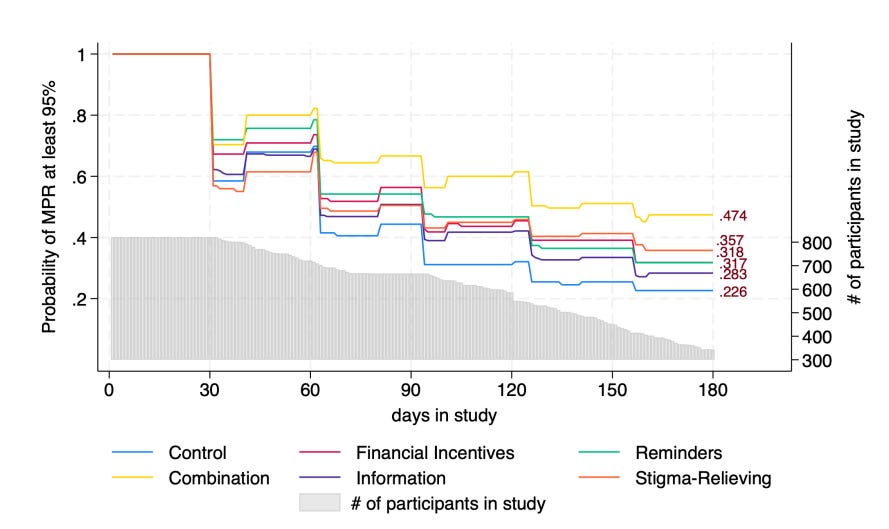
After 180 days, the adherence rates (i.e. MPR of >95%) were:
Control – 22.6%
Financial Incentive – 31.8%
Reminder – 31.7%
Combination – 47.4%
Information – 28.3%
Stigma-Relieving – 35.7%
The Combination group clearly performed better than other groups in the raw data.
What Improves Adherence?
Using a regression-based analysis to get more granular impact, YSRM found that financial incentives increase adherence by about 10.1 percentage points. Reminders increase adherence by approximately 11.6 percentage points. The Combination increases adherence by 24.3 percentage points, which is a bit more than the two interventions additively.
The fact that the Combination result is greater than the sum of the two interventions is actually an important result. It means that the two interventions are valuable on their own. Often, each additional intervention has less of an impact when combined with other interventions, since the interventions are targeting the same population. If one intervention leads to adherence, giving a second intervention would be wasteful. Thus, typically we should not expect two interventions to have an additive impact.
Why Do People Not Adhere to ART?
YSMR were also able to determine that inattentiveness and forgetfulness do occur. The Reminder group showed increased adherence by showing up for medicine refills even before the reminder call was made! This means that just the knowledge of a reminder call meant individuals were paying more attention to taking pills and thus, saw based on their pill count, that they needed to refill their medicine.
With regards to forgetfulness, YSMR noted that in the Financial Incentive group, ART adherence increased mainly by individuals who thought they were refilling their medicine before the due date, when in fact they were refilling after the due date (and thus did not receive the cash incentive). This tells us that the financial incentive made individuals think 30 days haven’t passed yet, when in fact 30 days did pass. Thus, the financial incentive acted as a type of reminder that one ought to go to get a refill.
Implementing Policies – Dealing With People’s Behaviors
Free ART on its own is a really beneficial policy – both for individuals and society. Uptake of this policy is, however, quite low, even though it’s extremely beneficial to the individual. Thus, another policy is introduced – financial incentive for ART adherence. Again, the impact of this was relatively muted. The YSMR study shows us that this lack of adherence is driven partially by human behaviors – inattentiveness and forgetfulness. Thus, what may look like a ‘failed’ policy, is actually a policy implementation issue. Adding reminders significantly boosted the adherence rate.This finding has also been established in other research. Banerjee et al. (2025) conducted a large-scale experiment in India on immunizations and found that a policy mix of financial incentives, reminders and outreach ambassadors increased immunization by 44%.
This has implications for many similar policies – especially financial incentives. Many policies are usually based on some form of financial incentive – lowering tax, increasing a transfer, providing a voucher or pre-loaded debit card. Take up of policies can fail as people are inattentive to repeated tasks or forget deadlines for applying for these programs. YSMR shows that it can be relatively cheap to improve uptake of these policies by adding a reminder mechanism such as a call (or maybe an app notification).
Governments on every level may find it beneficial to focus more on connecting citizens to already existing programs, rather than creating new programs or policies to address issues. New programs may similarly suffer from low uptake of old programs, as they do not solve the issue of inattentiveness or forgetfulness. Instead, focusing on outreach or incentives that reminds citizens to existing programs may be much more effective. The creation of such civilian outreach programs has been shown to have large positive impacts on communities, as citizens are made aware of what’s available to support them.
Let me know what else you think reduces the effectiveness of policies in the comments below.
If you would like to support us in reaching our subscriber goal of 7,000 subscribers, please consider sharing this article and pressing the like❤️ button at top or bottom of this article!
Interesting Reads from the Week
Mind the Failure Gap: Erman Misirlisoy, PhD discusses research about how people underestimate how often people and systems fail. This has implications for policy, especially in how people may view punishments for infractions.
Nobody could tell me what they’d pay for a robot: M G Fikru asks an interesting question, to which the answer is not as easy as it seems – how much would you pay for a robot that can do house chores? Let her know your response.
The Bureau of Economic Analysis (BEA) made a change (without announcing it) to how one of the inflation measures is computed. It lowered reported inflation by 0.1 percentage points. The lack of information about this change, however, is concerning:
Thanks for the shout out in the interesting reads section.
Great article, and thanks for sharing my post!
I've worked on adherence issues in the past in similar contexts. Back in the day, organizations used to assume they knew *why* adherence problems were happening (e.g. forgetfulness), so they'd launch a one-size-fits-all intervention without checking (e.g. reminders).
Now, organizations actually try to learn what's causing adherence issues first before trying to address it which is great. Some people drop out because of forgetting, others out of fear of the drug, others because of social stigma, others because they think they're already cured, others because they don't understand the importance of adherence, etc, etc. All of these need their own remedy.