


California recently voted on whether to impose a 5% wealth tax on individuals who had a net worth of at least $1.1bln. The result was ultimately a “no”. Many “no” campaigners and economists highlighted that such a wealth tax could result in wealthy individuals simply leaving the state, which could have had significant negative impacts on the state and its budget.
Were these concerns valid? One study – Ring (2026) – that looked at a recent increase in wealth taxes in Norway might help us think through this question.
Key Takeaways:
Doubling the marginal wealth tax resulted in approximately 100 wealthy Norwegians to emigrate;
Government revenues increases after accounting for migration and any change in income taxes;
Impacts on wealthy-owned businesses were limited, including on start-ups;
The higher wealth tax induces the rich to save more.
Nominal News is an economics newsletter written by a PhD Economist that translates the latest economic research into clear, policy‑relevant insights on current issues. Join 4,000 readers to stay-up-to-date with Nominal News directly in your inbox:

Norway’s Wealth Tax Reform
The Norwegian wealth tax policy is quite complex. Although the policy itself is not the main point of our article, some elements might be interesting to policymakers, so I have added them in the Appendix.
What is relevant is that during the 2021-2025 period, the changes in the wealth tax policy effectively doubled the highest marginal wealth tax rate – from 0.47% in 2021 to 0.88% in 2023. The Norwegian government also boosted other taxes on business owners – dividend taxes increased from 31.7% to 35.2%, while exit-tax1 loopholes were tightened.
Measuring Billionaire Migration
To track the decisions made by the wealthy individuals most impacted by the wealth tax changes, Ring looked at several data sources:
Public shareholder records, which contained data on where shareholders are domiciled (this information is needed to determine whether an individual migrated);
Public tax list reports – Norway makes data publicly available on taxable income, taxable wealth and taxes paid;
Magazine wealth rankings – top 400 wealthiest Norwegians.
The data sources are quite high quality and reliable – for example, of the top 400 wealthiest Norwegians, Ring was able to find the tax returns of 388 of them (the remaining 12 are likely foreign domiciled Norwegians).
Do Wealth Taxes Cause Millionaires and Billionaires to Leave?
With all this data, Ring was able to accurately track whether the wealthy migrated in response to the wealth tax reform. To do so, Ring first established the baseline outmigration of wealthy individuals prior to the wealth tax reform, which was then compared to the post wealth-tax reform outmigration rate.2
Ring found that:
Among the top 0.01% (400 individuals) cumulative outmigration between 2021 and 2024 went up from 4.5% to 9.5% (i.e., 5% more people migrated in the 3-year period);
Among the top 1% or top 10%, there was no change in outmigration.
Numerically, Ring estimated that about 100 extra people left Norway after the imposition of new wealth taxes. Moreover, Ring found that the main people who migrated were individuals whose wealth was most taxed due to the reforms – i.e., individuals who would benefit the most by emigrating.
This is also a reassuring result – it suggests that the data and Ring’s approach make sense. We should expect people who benefit the most from migrating to actually migrate.
Do Higher Wealth Taxes Actually Increase Tax Revenue?
The imposition of the new wealth tax significantly increased wealth tax-based revenue – after the reform, revenues went up 71.5%. Had the additional individuals not migrated, revenues would have gone up by 75%, meaning outmigration did still have a meaningful economic impact.
The increase in wealth taxes also appears not to have changed income tax revenues.3
The Role of Exit Taxes in Stopping Tax-Driven Migration
The Norwegian government also reformed exit taxes, removing a loophole that allowed Norwegians to temporarily relocate abroad and shield their capital gains. Ring found that this exit tax reform may have been a more meaningful driver of outmigration:
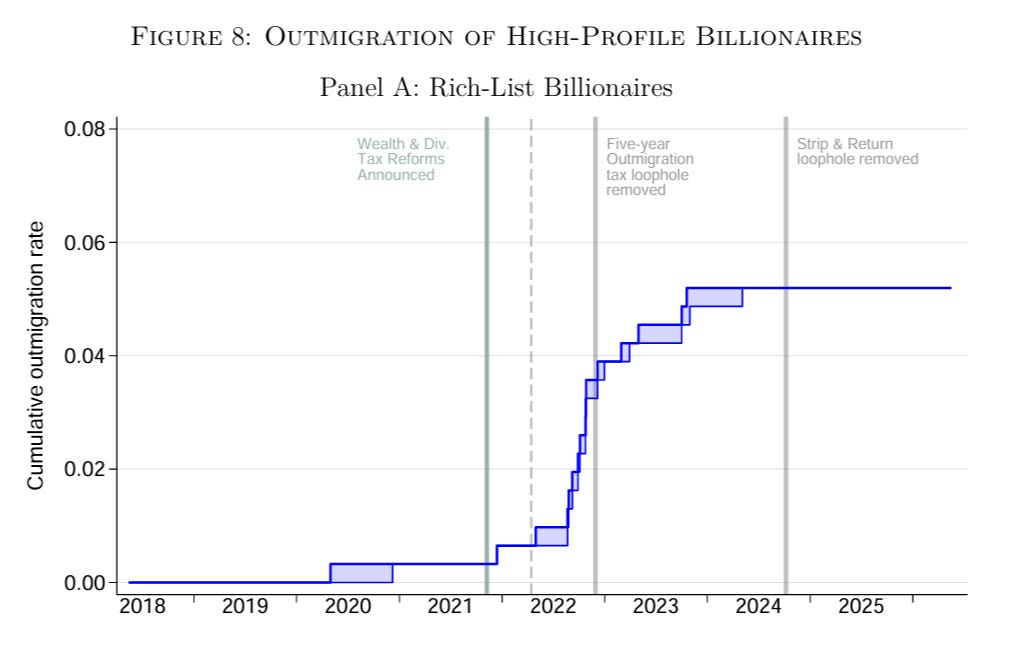
When the wealth tax rate increase was announced, outmigration did not increase in response to it. But in response to the announcement of the exit tax reforms, certain wealthy individuals chose to move before they came into effect. After the passage of the reforms, outmigration stabilized at a lower level.
Do Wealth Taxes Drive Away Entrepreneurs and Startup Founders?
Ring also looked at whether entrepreneurs or founders moved due to the wealth reform. This is based on the idea that a non-wealthy entrepreneur might choose to leave Norway before becoming wealthy to minimize their future tax obligations. Using LinkedIn data – which contains the business name and location of entrepreneurs – Ring compared migration rates of entrepreneurs between different Nordic countries. Ultimately, Ring found no change in migration rates in response to reforms – either entrepreneurs departing Norway or arriving in Norway.
How Wealth Taxes Affect Business Investment and Dividends
What happens to the firms whose owners have to pay higher wealth taxes? A common theory is that higher wealth taxes will push owners to invest less in their business and potentially take money out of the business to pay for the tax.
Ring found no change in business investment to the higher wealth tax. There was also no increase in dividends being taken out of operating companies. Ring did see that there was an increase in firms ‘exiting’ the market, but this was primarily driven by mergers, and not bankruptcies or firms being closed. Overall, there didn’t appear to be any noticeable firm-level response to higher wealth taxes.
Additionally, Ring also looked at how start-up investment changed. He found little change in Norwegian ownership of start-ups which received government grants, but he did find some evidence of lower Norwegian ownership eligible for R&D tax credits.
Do Wealth Taxes Alter Savings Behavior?
Ring also looked at a different question – do people increase or decrease savings in response to a wealth tax increase. Relying on Norwegian data again, Ring looked at how changes in assessed home value impacted wealthy individuals
In Norway, the value of your home is included as part of your taxable wealth. The home value is computed by the tax authority and, in 2010, a new method to assess home values was introduced, which used the location of a home in its calculation.
This created strict geographic boundaries – one street can be located in a higher value area, while the street right next to it might be located in a lower value area. Thus, two identical homes, one street apart, could have very different assessed values, which in turn, meant different amounts of tax owed.
Ring then linked the homes to administrative tax data, which enabled him to see how savings changed. In theory, it is ambiguous how households should respond to a wealth tax increase due to changes in home values:
A household can increase savings, in order to have the means to pay the higher tax due now and in the future (this is called the “income effect” – the tax makes you poorer so you have to work more/consume less);
A household can reduce savings and increase consumption today, as it reduces the amount you will be taxed today (this is called the “substitution effect” – the wealth tax makes it preferable to consume today rather than in the future)
Ring found that the first effect dominated – households started to save more. For every 1 Norwegian Krone (NOK) in additional wealth tax, households increased their savings by 3.76 NOK. Most of this increased saving was funded by increasing labor – i.e., working more – rather than by cutting spending.
This result is a bit surprising as it contrasts with what economists have often assumed, which is that the substitution effect would be stronger – i.e. a wealth tax increase would dissuade saving.
Key Takeaways: Are Wealth Taxes a Viable Policy?
Wealth taxes are an under-studied topic, in part due to the fact that we have not seen many countries implement them. The study by Ring suggests that wealth taxes can generate substantial additional revenue without significantly increasing outmigration or reducing business investment. However, we do observe some strategic responses: the wealthiest individuals do migrate in response to higher taxes, although this response becomes more muted by tightening exit taxes. The findings therefore support the potential viability of wealth taxation, but do not necessarily mean that there are no costs or that these taxes may be equally effective across jurisdictions.
At the same time, I would caution against extrapolating these results to all contexts (see appendix for a short discussion regarding California).
It is also worth considering wealth taxes as part of a broader set of tax policies. For example, the US allows for a ‘step-up’ basis at death, where all capital gains get reset when an individual passes away and transfers their assets to an heir. This means that there are no capital gains taxes upon death. When such a policy is in place and cannot itself be removed, an explicit wealth tax may be an appropriate replacement and may offset the fact that asset gains are never taxed.
P.S. Why California’s Wealth Tax Proposal Differs from Norway’s
First, Norwegian wealth taxes are relatively low, at less than 1%.
Second, unlike the California proposal, Norwegian wealth taxes are nationwide. It’s much easier to move between US states and avoid a wealth tax in a particular state, than it is to move between countries. Moreover, Norway imposed stricter exit taxes, making it much harder to move out of Norway for the sole purpose of reducing taxes owed.
Lastly, as we discussed previously, there is research showing that Norwegians may, on average, view inequality as more costly to society and themselves. Therefore, for strategic and ‘selfish’ reasons, wealthy Norwegians may be more accepting of paying the wealth tax given the benefits they believe they will receive. In countries where a lower share of people believe this, outmigration due to wealth taxes might be higher.
Appendix - Norwegian Taxes
The Norwegian wealth tax policy in 2021 had the following key elements:
Wealth in excess of 1.5mln NOK was taxed at 0.85%
To compute wealth – stocks were discounted at 45% to market prices (so a $100 stock would be valued at $55)
Unlisted stocks were valued at book value and the 45% discount is applied;
Cash and bonds were valued at market value
Homes were valued using a model designed by the tax authority
The value of a primary residence was discounted by 75%
The value of a secondary residence was discounted by 10%
Dividend taxes were at 31.68%
After 2021, the following changes were made related to the wealth tax:
The stock discount was reduced from 45% to 20%;
The wealth tax rate was increased from 0.85% to 1%;
The wealth tax threshold was increased from 1.5mln NOK to 1.7mln NOK;
A new marginal wealth tax rate of 0.1% was introduced for people with more than 20mln NOK;
Dividend taxes increased from 31.68% to 37.84%.
If you would like to support us in reaching our subscriber goal of 7,000 subscribers, please consider sharing this article and pressing the like❤️ button at top or bottom of this article! Sharing this article can earn you a free Paid Subscription.
Exit-taxes are imposed when individuals move assets abroad. Certain regulations previously allowed for effectively moving assets abroad without having to pay any tax.
Econometric note: we need to control for baseline outmigration, because if we do not, we would be overestimating the impact of the wealth tax reform. The main way we are looking to determine the impact of an increase in wealth taxes is to look at the pre-reform outmigration rate and compare it to the post-reform outmigration rate.
To evaluate the overall fiscal impact of tax increases, we would need to estimate how all tax receipts respond, which includes wealth, consumption, income, etc. taxes. This study does discuss wealth and income taxes, which are a significant part of the tax receipts (around 20% of GDP).