


Nominal News is an economics newsletter written by a PhD Economist that translates the latest economic research into clear, policy‑relevant insights on current issues. Join 4,000 readers to stay-up-to-date with Nominal News directly in your inbox:
Podcast
Below is the link to our companion podcast for this article:

This week (October 16) is the last week of our 40% off Launch Discount. Paid subscribers get access to the full podcast episode and all previous episodes, as well as bonus breaking news articles.
Countries differ by their level of inequality - below is map of countries by Gini coefficient (a measure of inequality):
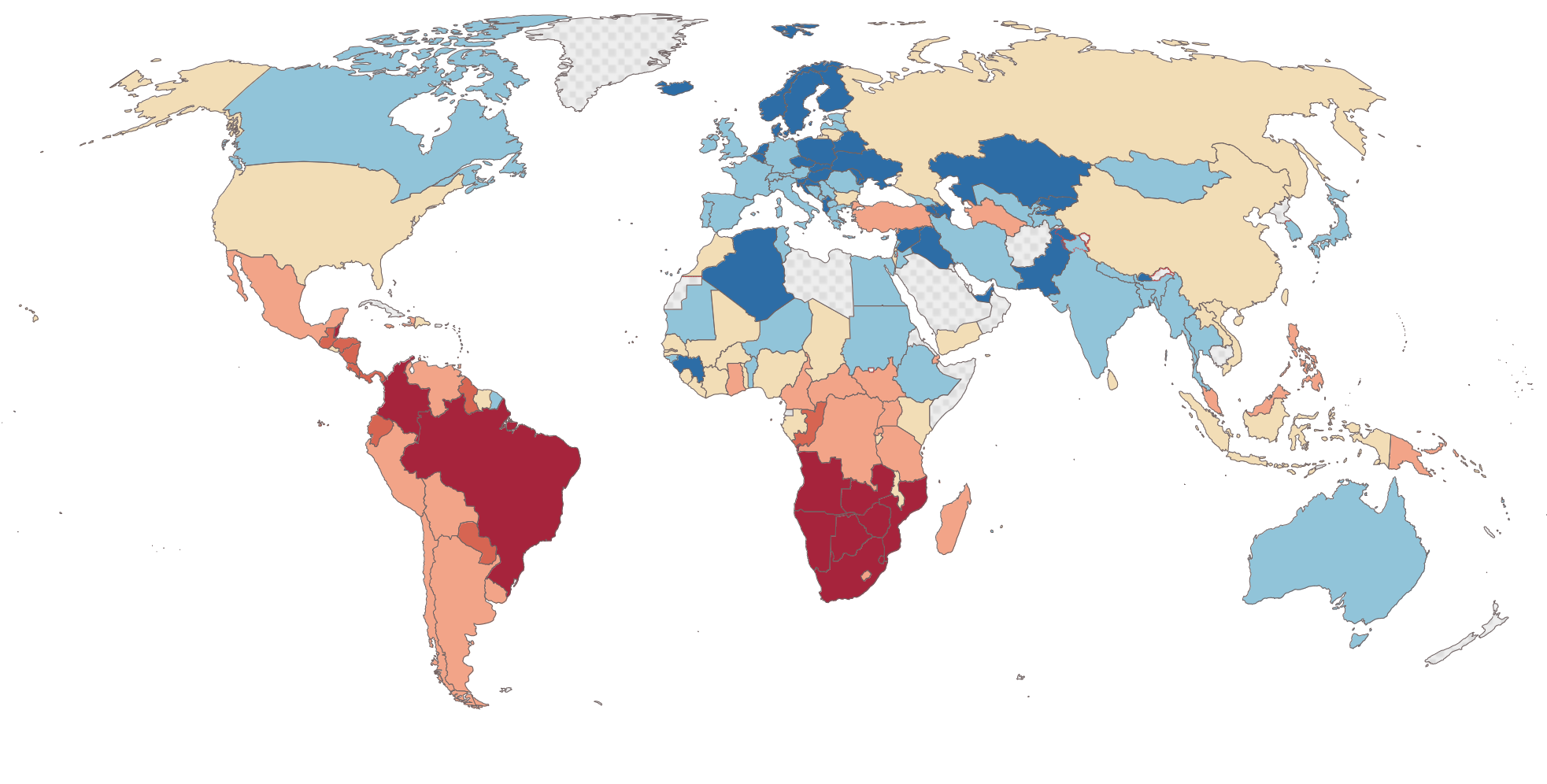
The dark blue countries have low levels of inequality, while dark red have high levels of inequality.
The Nordic countries are often presented as paragons of economic equality. Why they have less inequality is an open question – one suggestion is that the Nordic countries are altruistic societies. But what if it’s the opposite – people in these countries are more selfish?

Selfish Equality
Stostad (2026) investigated the idea that selfishness may matter for lower inequality in his recent job market paper. Stostad ran two laboratory experiments on volunteers from different countries. In these experiments, he asked participants to play a game.
The Dictator Game
A participant – referred to as the dictator – was told that they are splitting an amount of money between themselves and a recipient. Initially, the dictator was presented with one of two games:
An equal split game – $800 to the dictator and $800 to the recipient;
An unequal split game – $1000 to the dictator, $600 to the recipient.
The dictator is then given a choice to transfer some of their money to the recipient – either $0, $100 or $200. The dictator is told that the recipient will receive whatever the dictator decides.
In a slightly different version of the above games, the dictator is told that the recipient will see the dictator’s decision and have a decision of their own to make – the recipient can choose to take away $600 from the dictator, and in return, the recipient receives $100.1
Thus, in this version of the game, as the dictator, you are now worried about what the recipient may decide to do. It might be prudent to give the recipient some extra money, if it reduces the probability that the recipient will choose to ‘take’ away the dictator’s $600.
Importance of Personal Beliefs
If you are the dictator, you are trying to predict how the recipient will react. If I don’t offer them a transfer at all, what is the probability they will take away $600? Similarly, if I give them a $200 transfer, will that probability decrease and by how much?
Stostad asked the participants specifically what they believed the recipients would decide in response to their transfer offers. Specifically, Stostad asked the dictators how many recipients they think will take $600, if, as the dictator, they transfer $0 or $200.
The purpose of this question is to elicit what the dictator believes about recipients. As an example, suppose the dictator believes that if they transfer $0, 60% of recipients will take their $600, but if they transfer $200, then only 40% of recipients will take their $600. Based on this, it means the dictator expects to see a benefit of (60%-40%)*600 = $120 by giving the recipient a $200 transfer.2
The purpose of estimating this dollar benefit is to see how much the dictator expects to receive in exchange for offering the transfer. This number is important as it suggests a non-altruistic motive to the money transfer – if you expect a larger benefit, you may be more likely to offer the recipient a transfer.
Behavior of Non-Altruists
Stostad wanted to look, explicitly, at the behavior of non-altruists in these games.3 Non-altruists are defined as individuals who do not transfer any money to the recipients in the first dictator game – the game where the recipient has no choice but to accept whatever the dictator decides. In this dictator game, if you choose to transfer, as there’s no financial benefit to you, you may be doing it due to altruism.
By focusing on non-altruists from this first game, we can claim that if you choose to transfer money to the recipient in the second version of the game, you might be doing it out of ‘selfish’ reasons rather than altruism. That’s because by transferring, you’re hoping to dissuade the recipient from taking your $600. These non-altruists are referred to as ‘self-preserving redistributors’ – they re-distribute (i.e. transfer) out of selfish reasons.
Country Differences
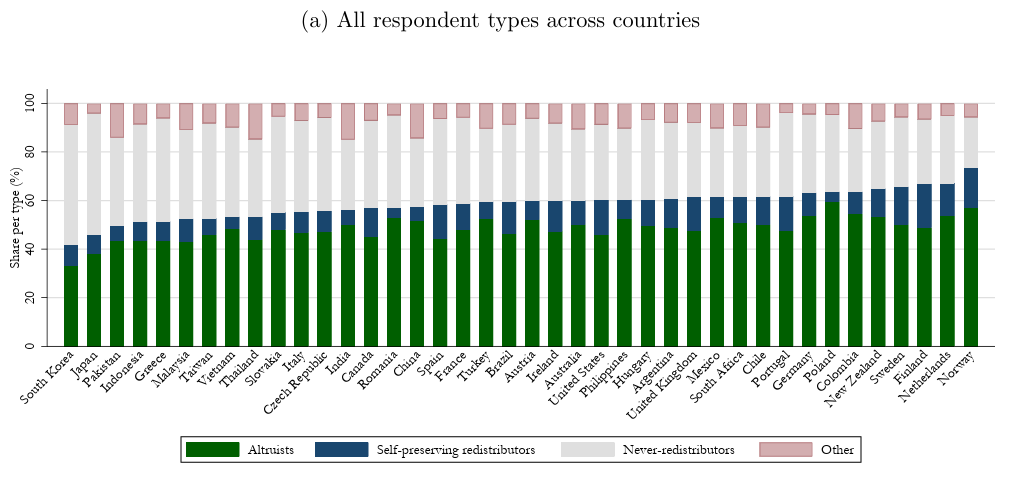
Stostad looked at how people in different countries responded to this experiment and categorized 4 types of respondents:
Altruists – people who transfer even though there is no benefit to them;
Self-preserving redistributors – people who only transfer when there’s a benefit to them;
Never-redistributors – people who never transfer money to others
Others – individuals who do not fit the above patterns.
The distribution of these individuals between countries is shown below:
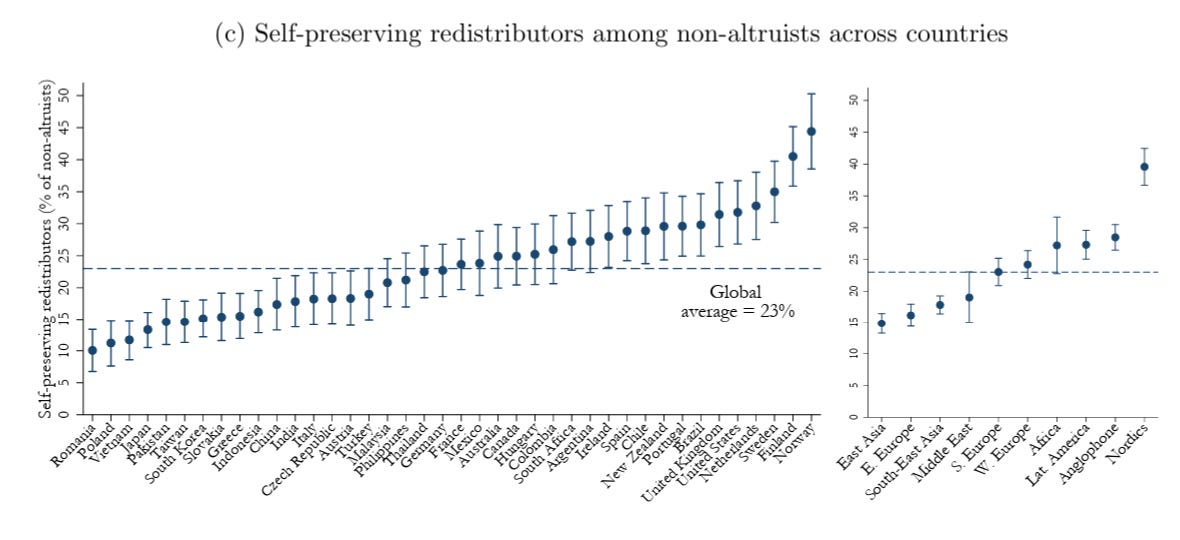
If we focus solely on non-altruists, the percentage of non-altruists that are self-preserving redistributors are shown below:
This result gets quite interesting when we look at the relationship between the self-preserving redistributors (x-axis) compared to how much each country transfers via government programs to the bottom 50% (y-axis):
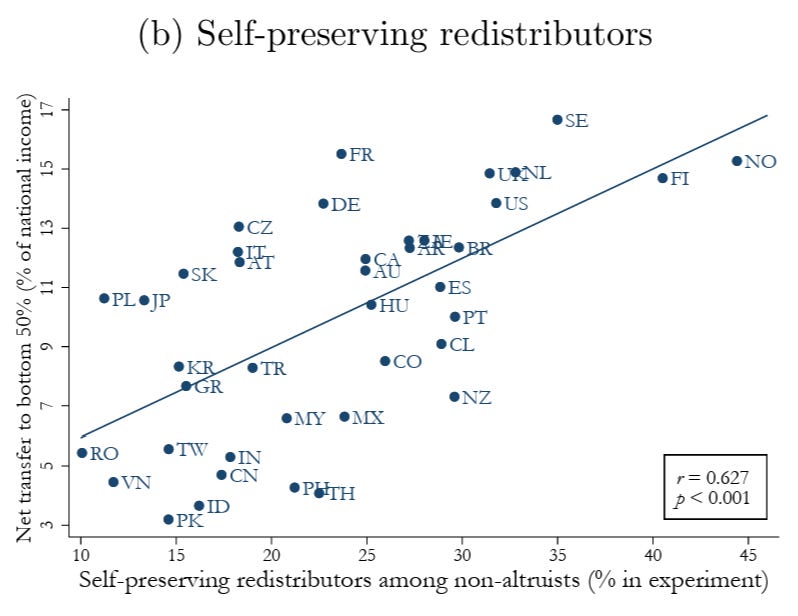
Countries that re-distribute more appear to have a larger share of self-preserving redistributors.
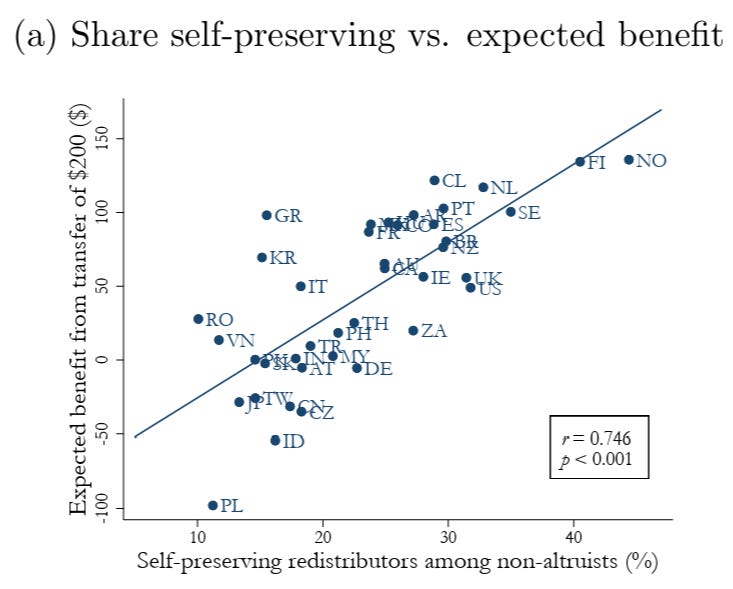
Moreover, if a country has more self-preserving redistributors, these self-preserving redistributors also believe that they will benefit more from transferring. The chart below shows the share of self-preserving redistributors (x-axis) against what they believe they will benefit from transferring (y-axis):
Lower Inequality Driven By More Selfishness
The above results suggest that people in certain countries may view inequality/unfairness as costly to them, because they may be ‘punished’ by recipients. They are more motivated to transfer money, to reduce the chances of punishment. These transfers are not motivated by any altruistic reason, but rather by purely selfish reasons motivated by one’s own beliefs on how recipients will react.
Stostad, with this paper, brings up a novel explanation of what might explain the differences in inequality levels between countries. It is not altruism, culture, history, etc., but, perhaps, selfishness and the beliefs about the costs of inequality. Naturally, this paper is not proof of this theory – Stostad is only presenting a correlation between the shares of self-preserving redistributors and the government transfer policies of countries. Moreover, the experiment itself might be somewhat limited, as people in experiments might not perfectly reflect real life behaviors.
However, this study opens up a new avenue of research and policy options. If inequality really is driven by people’s beliefs about the costs of inequality to them, then understanding and communicating the true costs of inequality to people becomes critical. Reducing inequality is not free – transfers need to be funded by tax revenues which have economic costs. But if inequality itself has costs to members of society such as increased crime, higher social unrest and lower social trust, then there might be an optimal amount of redistribution needed to reduce these costs.
If you would like to support us in reaching our subscriber goal of 7,000 subscribers, please consider sharing this article and pressing the like❤️ button at top or bottom of this article!
In this version of the game, $500 is ‘lost’.
It’s worth noting that the benefit of transferring $200 is only $120, so, on net, the dictator loses $80 in expectation.
Given the low stakes in this experiment, it’s difficult to definitively establish if people are acting out of pure altruism when they transfer money, or whether they want to look good in front of the experimenter.
This is fascinating