


Nominal News is an economics newsletter written by a PhD Economist that translates the latest economic research into clear, policy‑relevant insights on current issues. Join 4,000 readers to stay-up-to-date with Nominal News directly in your inbox:
Summary
The FOMC (the interest rate setting committee) decided by a split vote (9-3 ) to keep interest rates between 3.5% and 3.75%.
The 3 voters wanted to increase interest rates to 3.75% - 4.00%.
Warsh’s press conference after the decision had a lot of contradictions and somewhat concerning statements.
Commentary
The Decision
In advance of today’s meeting, the probability of rate hike was quite high (between 30% and 40%), which made this meeting more important than normal.
The decision by the FOMC to keep rates steady was widely expected, although the fact that 3 voting members dissented is something we do not see often. The reason for the dissent was most likely driven by the fact that forecasts for June inflation remain elevated.
Current forecasts suggest that 12‑month inflation will be at 3.3% for core (excluding food and energy) PCE (Personal Consumption Expenditure) and 3.7% for headline PCE. On a month-to-month basis, Core PCE inflation is expected to be up in June by 0.18%, which gives an annualized inflation rate of around 2.2%. Note, that although the monthly rate is in-line with the the 2% target, recent US government decisions around the war in Iran and tariff re-enactment suggest future inflation pressures.
Last time, when the FOMC met in June, I mentioned that it was surprising that the vote to hold interest rates steady was unanimous (12-0). This time, no such surprise. I could believe that the vote could have been even closer given some recent statements made by FOMC voters.
What’s interesting is that Kevin Warsh did not vote for the hike. Although his individual vote to hold rates steady was expected, there is a bit of tension between his rhetoric of committing to a 2% inflation target, which would probably necessitate an interest rate increase, and his prior statements that interest rates need to be cut.
For example, from a statement he made 1 year ago.
“Their hesitancy to cut rates, I think, is actually ... quite a mark against them,” Warsh told CNBC. “The specter of the miss they made on inflation, it has stuck with them. So one of the reasons why the president, I think, is right to be pushing the Fed publicly is we need regime change in the conduct of policy.”
This tension between his prior statements and current economic reality may be his influencing voting behavior.
The Statement
Below is the latest FOMC statement, with changes highlighted in comparison to the June FOMC statement:
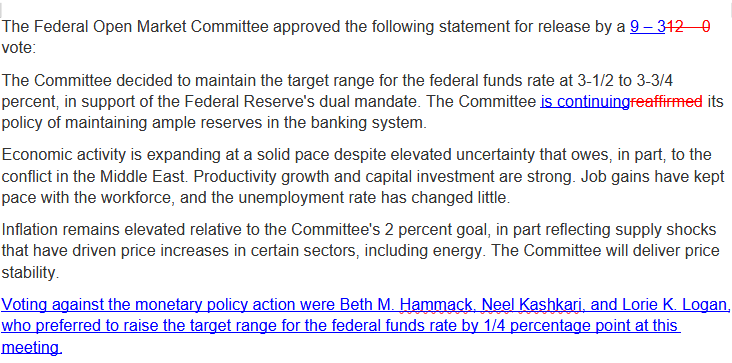
The statement has only minor changes referencing the fact that there were dissenters.
Although last time I interpreted the language around productivity growth and capital investment as suggesting what was discussed specifically at the meeting, my current reading is that it is a boilerplate statement. Therefore, not much can be gleamed from this statement.
Kevin Warsh Press Conference
Kevin Warsh had held his press conference after the decision. It was quite astounding - and not in a good way.
Prepared Statement (57:20 - Video)
The beginning of the prepared statement closely followed the officially published statement. Kevin Warsh reiterated that he will not provide forward guidance, because it would not be prudent during “these uncertain times” (note - this contradicts something he said later).
Kevin Warsh then bizarrely focused on criticizing the work done by the Federal Reserve over the last 5 years. Some quotes:
“5 years of high inflation has left a mistaken impression that’s hard to shake'“
“we have begun a new chapter and we understand that the 5 plus years of inflation above target cannot be cured in 9 weeks”
First, many of the current FOMC members were also FOMC members during these 5 years. Thus, Warsh appears to be insinuating that they’ve done a bad job.
Moreover, Warsh completely ignores the fact that when controlling for lagged rent data (something Warsh would advocate for with his emphasis on real-time data), inflation did drop to 2%. Thus, the criticism can be considered unfair.
The criticisms did feel more political in nature, rather than economic.
On Forward Guidance
From the press conference, it is clear that Warsh is laser focused on one thing - removing ‘forward guidance’.
As a quick reminder, forward guidance is the practice where central banks telegraph future monetary policy decisions. The purpose of forward guidance is increase central bank credibility in front of market actors. With this credibility, central banks do not have to make drastic policy changes to get inflation under control. That’s because market participants will anticipate what the central bank will do.
Warsh believes markets should not be informed about the exact choices the Federal Reserve will make. That’s because he believes it should be the other way around - market decisions should be act as an information signal for the Federal Reserve. Forward guidance influences market decisions and, thus, contaminates this signal that markets send to the Federal Reserve.
The problem I have with this idea is that central bank credibility is hard to establish, while the market signal can probably be extracted by other ways (e.g. directly talking to businesses). Moreover, I’m not sure why markets reacting pre-emptively is inherently a bad thing.
Separately, in a latter part of the conference, Warsh recounts how during a crisis (referencing the 2008 financial crisis), forward guidance was needed to help ease concerns. But his belief is that during ‘benign’ periods, forward guidance is bad.
This seems contradictory to me, especially since he has called the current times as ‘uncertain’.
Market Reaction - Another Contradiction (1:05:20 - Video)
Warsh puts a lot of emphasis on not having forward guidance because he wants unfiltered market data (i.e. not contaminated by the Fed’s future decisions).
A reporter then asked about how he interprets the financial market data which currently appears to suggest that interest rates should be higher. Warsh responds:
“Interpreting markets is an imperfect business”
And does not provide any additional relevant response to the question.
This wasn’t a promising answer. Quite the contrary - it’s a bit concerning.
If he wants financial market data, but he doesn’t know how to interpret it, then I’m not sure what’s the point…
Data Dependence - Another Contradiction (1:08:45 - Video)
Warsh was also confusing about using data. From the previous conference, Warsh emphasized the need for new data. During this press conference, Warsh says he does not like “data dependence”, but he cares about “trends on the data”.
Again, I’m stumped. What is the difference between data dependence and the trends in the data? Economists always look at trends and not just indvidual data points, if that is what he’s referencing.
The concerning interpretation of this statement is that Warsh is likely to pick and choose what data fits a particular narrative, he may want.
Comments on the FOMC Members
Lastly, throughout the press conference, Warsh kept reiterating how he has become more confident in the group working with him at the FOMC. He feels more certain than ever that the FOMC group will get inflation to the 2% rate.
This sounds like a harmless statement, but I found it a bit peculiar.
Many of the FOMC members have been on the FOMC for some time. By emphasizing that he feels more confident in the group, Warsh makes it sound like he was skeptical when he joined the Federal Reserve that these people would be good professionals. The repeated emphasis that he now trusts them after 9 weeks on the jobs seemed peculiar to me.
An Even More Concerning Press Conference Than in June
The decision to keep rates steady was not a big surprise. Neither was the fact that there were dissenters. The press conference, however, was something much more surprising.
It appears that Warsh is concerned by inflation, but does not want to raise interest rates, believing that just higher US treasury rates will suffice in slowing down the economy (which in turn, would reduce inflation). If that were the case, then we wouldn’t even need the Federal Reserve, as markets could control inflation by themselves. But we know that this is not true.
More broadly, although mistakes in monetary policy today might not have grave consequences, my concerns are what will Kevin Warsh do during a more pronounced crisis - such as the Great Recession of 2008 or the Covid pandemic.
His answers to questions left a lot to be desired, and it was quite clear that there were lots of contradictions in these answers. This does not bode well for crisis situations.
Perhaps confusion was the intent - if what the Fed says is contradictory, then we can’t have ‘forward guidance’.
Finally, let me just leave you with the reaction of the US 10 Year Treasury yield at the time of writing this article:
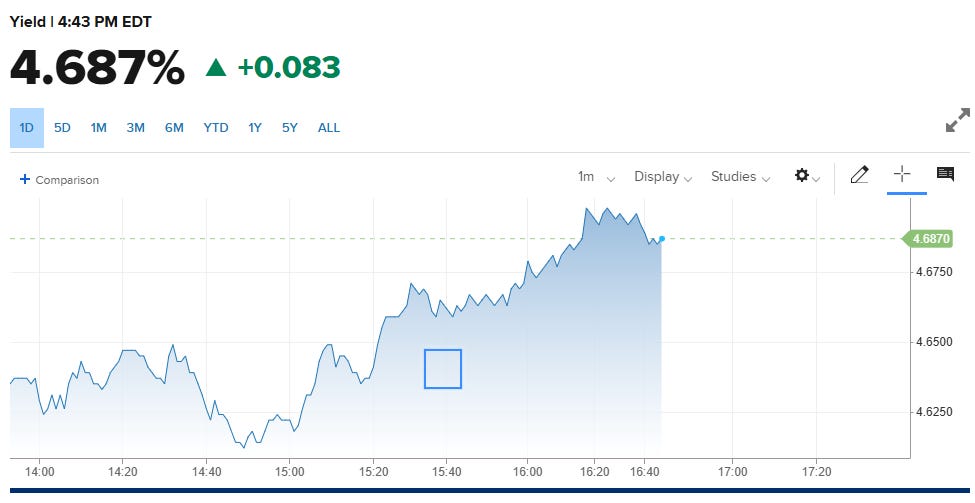
I think the signal here is that the markets really didn’t like this press conference.
This has been a special edition Nominal News article covering a very recent development. Please let me know your thoughts on this feature, and what would you like to see covered, in the comment section below.
If you would like to support us in reaching our subscriber goal of 7,000 subscribers, please consider sharing this article and pressing the like❤️ button at top or bottom of this article!
I bever understood the fears of a hike this meeting.
What a clown.