


Nominal News is an economics newsletter written by a PhD Economist that translates the latest economic research into clear, policy‑relevant insights on current issues. Join 4,000 readers to stay-up-to-date with Nominal News directly in your inbox.
We just launched Paid Subscriptions now that I officially went full-time and am currently running a 40% discount launch special. Paid Subscribers will get ‘live’ reporting on economic events, audio discussions of articles and ad-hoc economic analyses.
Corporate profits are rising to record levels in the US. Part of this increase can be attributed to Trump’s corporate tax cuts enacted as part of the Tax Cut and Jobs Act (TCJA) passed in 2017. Under this Act, corporate taxes were reduced from an approximately 35% tax rate to a flat 21% tax rate. Given this large corporate tax cut, many are proposing restoring the corporate tax rate. But is that a good idea?

Corporate Tax Cuts, Wages and Employment
Nearly all taxes are distortionary, as they change people’s behavior. Corporate taxes are no different, which is why Kennedy, Dobridge, Landefeld, and Mortenson (2026) (“KDLM”) looked at what the impact of the TCJA corporate tax cuts was on:
Firms’ hiring decisions;
Workers’ wages;
Firm profits.
If you’d like to skip over the methods of the paper and go straight to the results, please scroll to section II.
I. Methods Section: How KDLM studied this question
To study the impact of corporate tax cuts, KDLM used corporation tax filings from 2013 to 2019. In addition to these filings, KDLM had access to employee tax filings at these specific corporations (this data is called Linked Employer-Employee Data). It’s worth emphasizing that KDLM did not use survey data or estimates, but actual tax filings, which allowed KDLM to precisely observe firm revenues, worker/owner incomes, firm expenditures, etc.
It might be tempting to assume that the next step would simply be to look at how firms’ tax filings changed from pre-TCJA cuts to post-TCJA cuts, but this would be incorrect. That’s because under such an analysis, you’d be capturing not only the change in corporate taxes, but also anything else that was changing during that time period (like GDP growth or other regulatory changes). Your result would be incorrect. So what did KDLM do to deal with this?
C-Corporations and S-Corporations
The US tax code is extremely complicated, but occasionally it works out great for economists. KDLM noted that there are two types of corporations in the US: C-Corps and S-Corps. The main tax difference between them is that owners of C-Corps are double taxed. First, the C-Corp pays a corporate tax and then, C-Corp owners have to pay a dividend tax if they take out money from the C-Corp. For owners of S-Corps, on the other hand, there is no corporate tax - all the income generated by an S-Corp flows to the owners who pay standard income tax (like workers).
In addition to the corporate tax cuts for C-Corps, the TCJA also cut income taxes (which benefited S-Corp owners) and also gave S-Corp owners one other tax benefit that allowed them to lower their taxes.1 The TCJA ended up reducing taxes for C-Corps and S-Corps but at different amounts; C-Corps saw tax rates drop from 35% to 21%, while S-Corps saw effective marginal tax rates drop from around 40% to 29%. The chart below shows how the marginal tax rate (left chart) changed between the two types of corporations, and how the observed (in the tax filings) marginal tax rate changed.
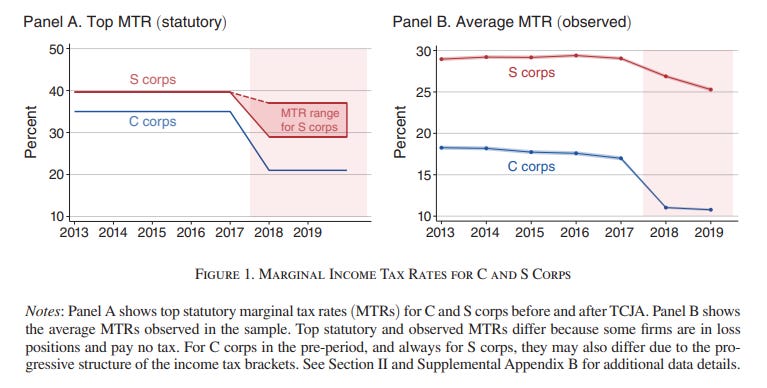
This tax code difference resulted in C-Corps paying 26% less tax relative to S-Corps, leading to a 5.5% higher rate of return for C-Corps. Using C-Corps and S-Corps that are similar in size and operate in similar industries, but saw different tax reductions, KDLM could estimate the exact causal impact of tax cuts.2
So what did they find?
II. Impact of Corporate Tax Cuts
For a 1% increase in the net-of-tax rate (this is the share of income left after tax or 1 minus the tax rate)3, C-Corps saw:
The amount of capital (e.g. machines) increase by 0.82%;
Payroll (i.e. total wages paid) increase by 0.37%;
Employment increase by 0.23%;
Taxable income increase by 0.7%.
This tells us that corporate taxes do distort business decisions - with lower corporate taxes firms invest more, hire more, pay more and generate more revenue/sales (taxable income is higher). (As an aside, this is the typical cost of taxation, referred to as deadweight loss of taxation).
Now although we see that reducing corporate taxes increases economic activity, who actually benefits from this increase?
First, after-tax profits rise by 1.06% for every net 1% increase in net-of-tax rate (for the tax cuts received by C-Corps, this would imply an approximately 23% increase in after-tax-profits). So we know that shareholders benefit, but do workers?
Worker Wages
Perhaps surprisingly (or unsurprisingly), only workers in the top 5% of the income distribution at each corporation benefited from the TCJA tax cuts. The 95th percentile worker saw 0.22% rise in wages for every 1% increase in net-of-tax rate. For reference, these are workers that earn on average $170,000 and saw a $2,100 increase in wages.
A bigger increase went to executives - the top 5 highest paid employees (earning an average $375,000) saw a 0.47% increase in wages for every 1% increase in net-of-tax-rate. This translated to approximately a $9,700 increase.
Could these executive wage increases be justified? A common argument made in favor of executives is that they are the decision makers, which leads to firm growth and profitability. KDLM looked at several potential variables - sales growth, profit growth and relative sales growth to competitors. KDLM did not find any of these variables to explain the executive wage increase, suggesting that executives were simply engaging in rent sharing (i.e. executives earned higher wages without a corresponding increase in business performance).
Distributional Impact
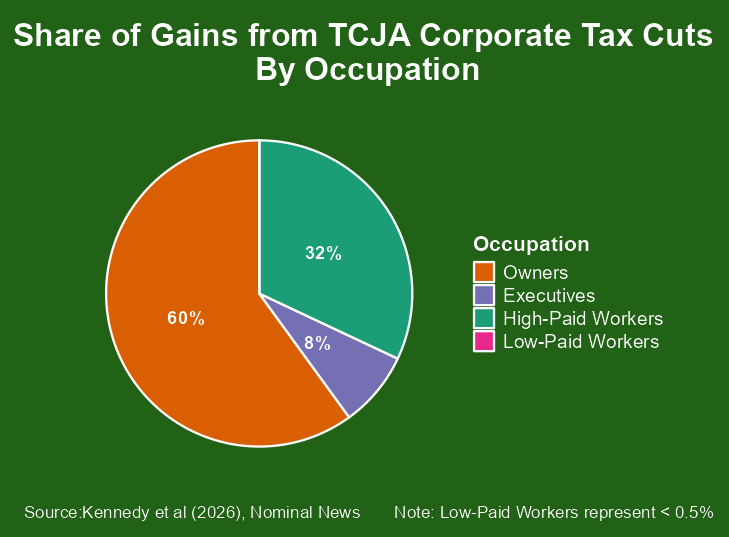
Lastly, KDLM looked at the full picture of the distributional impact of tax cuts.
60% of gains flow to owners,
8% to executives,
32% to high-paid workers (top 10% of national income distribution)
0% to low-paid workers (bottom 90% of national income distribution)
Since workers can have shares and be owners, KDLM also looked at how the gains were distributed by income (versus by occupation):
The top 1% got 33% of the gains from the corporate tax cut;
The 90th percentile to the 99th percentile got 55%;
The bottom 90th percentile got 13%.
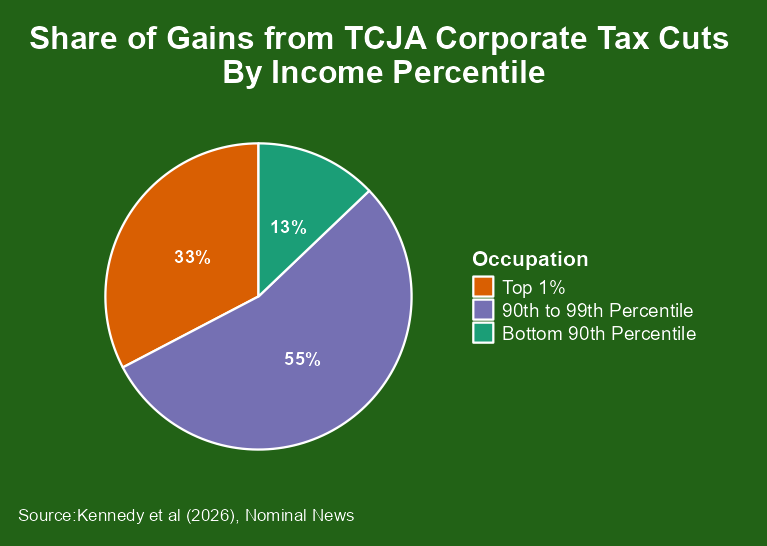
Thus, whether looking by role or by income bracket, the gains predominantly accrued to the top of the distribution.
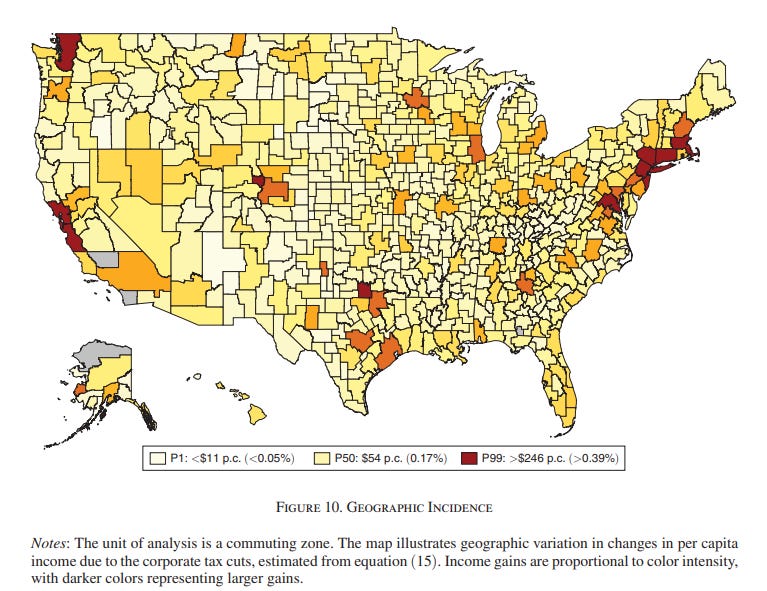
Interestingly, KDLM also found that 20% of the corporate tax cut benefits went to foreigners (foreigners can hold shares in C-Corps). Within the US, the gains mostly accrued in the Northeast and West of the US (darker color implies bigger gain):
III. What To Do With Corporate Taxes
Corporate tax cut proponents will argue that these taxes distort the economy and reduce growth, which is true. Corporate tax cut critics will argue that they increase inequality, which is also true. This makes corporate taxes very controversial.
Prior to writing this article, I viewed corporate taxes as an inefficient tax. Since a corporation is not an actual person4, I always considered focusing on the taxation of people that benefit from corporations - owners (capital/dividend tax), executives and workers (labor tax), and consumers (sales tax). Moreover, corporate taxes also create a global ‘corporate-tax’ race with many countries offering a zero-corporate tax policy as an incentive to encourage corporations to move. This ends up creating plenty of bloat, where corporations work on optimizing for tax purposes, which, one can argue, does not create real value.
However, as the KDLM paper shows, cutting corporate taxes acts as a regressive tax, as the cuts benefit high income individuals far more than low income individuals. It is worth noting (and KDLM mention this) that we do not know about other benefits corporate tax cuts may have, such as firms offering lower prices, which benefits consumers. I am, however, skeptical that even accounting for these other benefits would offset the regressive impact of the tax.
So what should we do about corporate taxes? Raising them may be one option, but we do not know if we will observe the reverse effects of corporate tax cuts - that is, higher-income individuals will ‘pay’ most of the corporate tax increase. Alternatively, the corporate tax cut should be offset by accordingly raising other taxes that will target beneficiaries of the corporate tax cuts. This would entail raising capital/dividend taxes and raising the marginal tax rate for higher-income individuals.
So to offset the corporate tax cut (or any future corporate tax cut), the marginal tax rates (labor, capital) on its biggest beneficiaries, the top 10%, would need to be raised. This would shift more of the tax burden on the groups that gained the most from the tax cuts. However, if such taxes cannot be raised, then the issue of raising corporate taxes may be warranted.
If you would like to support us in reaching our subscriber goal of 7,000 subscribers, please consider sharing this article and pressing the like❤️ button at top or bottom of this article!
Nominal News - Recent Paid Article
On Friday, I posted my first paid article in anticipation of the FOMC meeting on September 16. Below is the article, which I have unlocked for all. My next paid article will cover the FOMC meeting this Wednesday - if you’d like to access it, please consider upgrading to paid.

The Qualified Business Income deduction.
You can think of C- and S-Corps as twins. The TCJA basically treated one twin with a larger tax cut and the other twin with a smaller tax cut. Since everything else is the same for each type of corporation (like regulations, how the broader economy does, etc.), any differences in outcomes must be due to the change in the tax rate.
As an example, the reduction in corporate taxes from 35% to 21% would approximately result in a net-of-tax rate increase from 65% to 79%, which is a 21% increase (14/65)
In the US, the Supreme Court ruling, under the Citizens United case, partially made corporations a person.
Yes.