


Nominal News is an economics newsletter written by a PhD Economist that translates the latest economic research into clear, policy‑relevant insights on current issues. Join 4,000 readers to stay-up-to-date with Nominal News directly in your inbox:
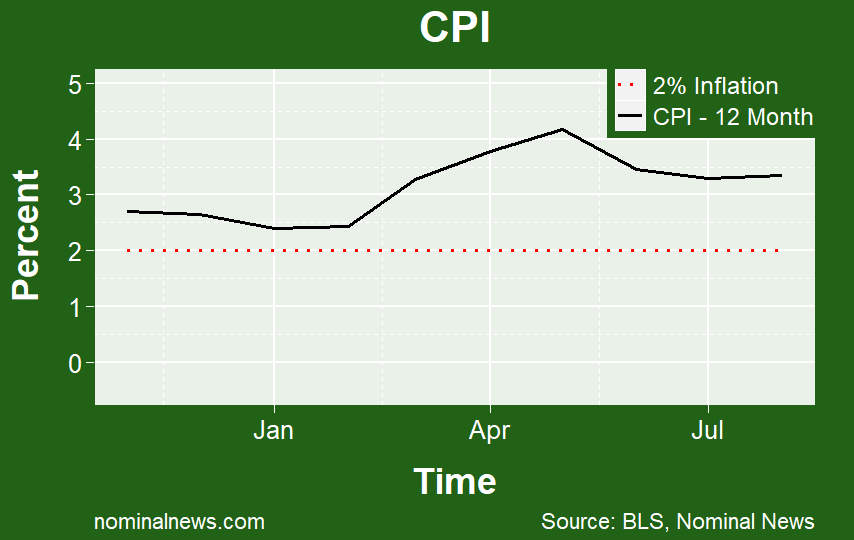
This morning, the Bureau of Labor Statistics (BLS) released the Consumer Price Index (CPI) data. The headline CPI came in at 0.4% month-over-month, 3.4% year-over-year, while Core CPI (not including food and energy) came in at 0.3% month-over-month and 2.4% year-over-year.1
Another data release published on Thursday - the Producer Price Index (PPI, the price that sellers receive) - also came in hot. Headline PPI came in at 5.4% on a year-on-year basis, while Core PPI came in at 4.7% year-on-year.
Although CPI is not the main inflation measure used by the Federal Reserve - that is the Personal Consumption Expenditure Price Index (PCE) - the CPI and PPI data feed heavily into PCE. Based on the releases so far, forecasters are assuming a high print for August PCE as well.
Moreover, the latest PCE readings for the month of July were far above the Federal Reserve target of 2% - headline PCE was 3.7%, while Core PCE was 3.3%. With inflation being above target, the focus has turned to the interest rate decision that will be made on September 16, 2026 by the Federal Reserve. The big questions are whether the Federal Reserve will hike, and whether they should hike.
Below I lay out how to think through this decision using a standard economic model. I will also address why I think many opinions are off the mark in this current interest rate discussion:
“It’s a supply shock, we shouldn’t hike into a supply shock”
“Inflation is actually low and falling so we shouldn’t hike”
“The labor market is weak and thus we shouldn’t hike”
What you’ll find below:
Why I believe that the standard economic models suggest an interest hike is needed;
What are the primary reasons of current inflation pressures;
My responses to common opinions on current inflation and interest rates.

Bringing in a Framework - the New Keynesian Model
To understand where inflation is heading in the next several months, we need to look at the workhorse economic model - the New Keynesian model. In this model, inflation is determined by three elements:
real marginal cost;
the level of desired mark-up; and,
inflation expectations.
The key elements we need to worry about today are real marginal cost and inflation expectations.
Real Marginal Cost
Real marginal cost is the input cost for firms to make one additional unit of a good or service. Thus, anything that affects the supply of inputs will push real marginal cost up. The largest recent increase in real marginal cost was the oil price spike. But besides oil prices, there have also been other cost spikes:
Tariffs;
Reduction in immigration.
Both of the above government policies also increase the real marginal cost of producing an extra unit, albeit to a lesser degree than the oil spikes.
Since these costs have spiked, inflation in the US has accelerated since the beginning of the year:
What Brings Inflation Down
The Federal Reserve can respond to this increase in inflation by raising interest rates. The main way raising interest rates works in reducing inflation is by making it costlier for businesses to operate (raising the cost of capital). This in turn reduces employment, which reduces wages. Lower real wages directly reduce the real marginal cost, bringing inflation back down.
Raising interest rates negatively impacts the labor market, but what if the Federal Reserve doesn’t hike interest rates?
Inflation Expectations
The other key driver of inflation is inflation expectations - what market participants believe inflation will be. This is used by firms (and workers) for price setting (for wage negotiations). Inflation expectations can make inflation a self-fulfilling prophecy - if I believe inflation will be 5% next year, I set prices today 5% higher, making inflation next year equal to 5%. That’s why central banks focus on inflation expectations and want to keep them anchored to the target they set.
In our case, if the Federal Reserve doesn’t hike and lets inflation remain elevated, there is a worry that everyone will no longer believe the 2% target and assume a higher target. This un-anchoring is dangerous, as re-anchoring the economy to a 2% target may require much much larger interest rate hikes to convince market participants to change their inflation expectations.
Why I Think a Hike is Warranted
Using the above model, I see two main concerns that impact both real marginal cost and inflation expectations:
Higher inflation over the last 6 months impacting expectations;
The continuation of government policies that all increase the real marginal cost.
All the government policies that have increased inflation over the last half year are still present. The war in Iran is unlikely to end any time soon. Tariffs are being brought back. Immigration is being made more costly and more difficult. All of these policies only point in one direction - higher real marginal cost.
At the same time, markets are catching on to the idea that inflation will be higher for longer - yields on US Treasuries are at record highs suggesting that the markets expect the Federal Reserve to raise interest rates. The worry now is that these inflation expectations may have become entrenched.
As inflation has now been elevated for many months and primarily driven by government decisions, a lack of action on the part of the Federal Reserve may signal that the 2% target is fluid. This on its own warrants a hike.
But, moreover, if inflation remains elevated in the next few months, as I expect, the Federal Reserve will almost certainly need to hike later in the year. Given that there are larger risks to not hiking interest rates, I believe the interest rate hike might as well come in now.
So if I were a voting member of the FOMC (the committee that sets interest rates), pencil me in for a hike.
Answering Some Common Statements
“We shouldn’t hike interest rates into a supply shock”
There is no economic rule that says not to hike into a supply shock. The main reason why we would avoid hikes is if we believe the supply shock is temporary. For example, suppose a hurricane reduces oil shipments. We know the hurricane will end, and thus we do not need to change interest rate policy, but rather let inflation be elevated for a bit.
In the current case, all the supply shocks (war, tariffs, reduced immigration) are driven by government policies. These policies have been with us for several months with no plan to end them. As they are not temporary, it is not your typical supply shock.
“Inflation is actually low and falling, so we don’t need to hike”
It is true that core CPI has fallen. However,
The main inflation measure we use is PCE, which hasn’t fallen;
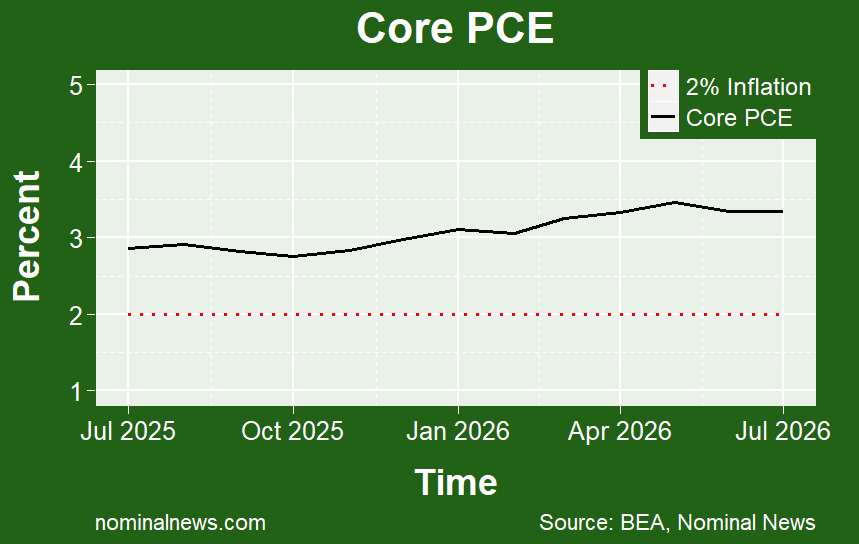
With Federal Reserve decisions, we need to be forward looking. As there is limited disinflation going forward, we should expect inflation to creep up, absent any Federal Reserve actions.
“The labor market is weak and thus we shouldn’t hike”
The labor market is mixed - with both strengths and weaknesses. Unemployment is low at 4.1%. Wage growth is a bit more mixed - certain estimates have it at 3.1% while others at 3.6% (for job stayers). This is basically zero real wage growth. The problem, however, is that inflation is still elevated and climbing. Absent government policy changes, the only way to bring inflation down is through further real wage deterioration. Unfortunately, workers often take the brunt of inflation reduction.