


Nominal News is an economics newsletter written by a PhD Economist that translates the latest economic research into clear, policy‑relevant insights on current issues. Join 4,000 readers to stay-up-to-date with Nominal News directly in your inbox:
Summary
The FOMC (the interest rate setting committee) decided by a unanimous vote (12-0) to raise interest rates to a range between 3.75% and 4.00%.
Most FOMC voters expect to hike interest rates at least one more time this year.
Of concern, Warsh argues that inflation is driven by the fact that the US economy has ‘strengthened’, although data suggest otherwise.
Commentary
The Statement
Below is how the FOMC statement has changed from the previous FOMC meeting:
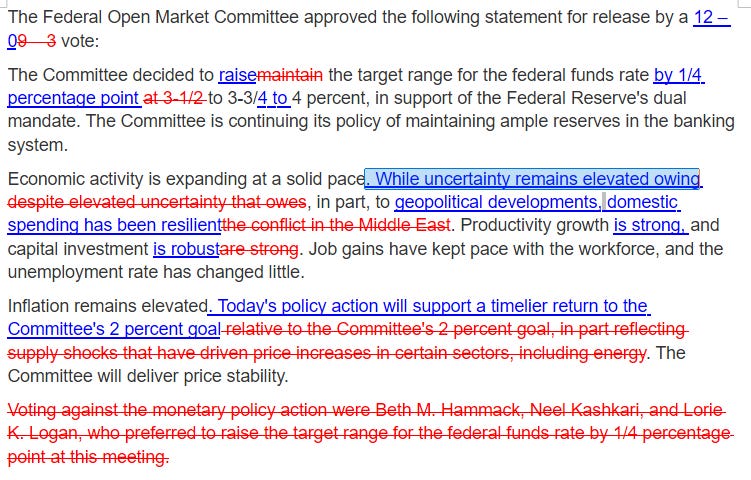
The interest rate hike was expected by markets and is most likely the right decision, as I argued here. Perhaps somewhat surprisingly, there were no dissents, either for holding rates steady or for a further interest rate hike. In addition to the statement above, the Federal Reserve has also published what FOMC participants forecast macroeconomic variables to be in the following years - GDP, unemployment, inflation, and interest rates.
What you’ll find behind the paywall:
Why subtle changes in the Fed's wording signal another rate hike is coming;
What the Fed’s new forecasts tell us about future rate hikes;
Why I disagree with Warsh’s diagnosis of what is really driving current inflation;
My own scenario-based forecast for interest rates and inflation.
We are currently offering a 40% discount off of all subscriptions!
Interpreting the Statement and Decision
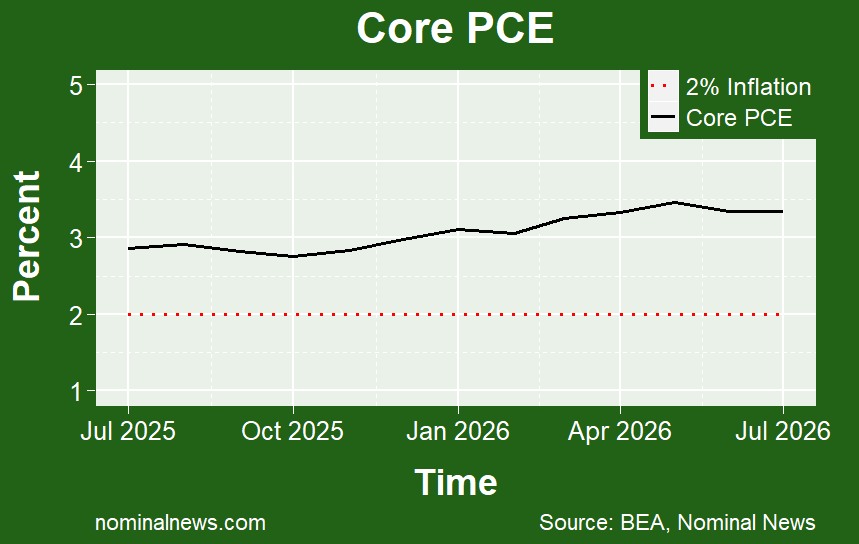
As we mentioned in our previous piece, inflation is running hot. As the Core PCE chart below shows, inflation has remained above 3% since the beginning of the year and accelerated as the year progressed.
The FOMC statement contains two noteworthy changes:
The statement no longer references supply shocks or energy.
The statement notes that the committee wants a “timelier return to the Committee’s 2% goal”.
The first point suggests that the FOMC is looking at multiple sources of inflation, not just energy inflation. As I have discussed, there are three factors that are pro-inflationary - tariffs, war and the suppression of immigration.
While the energy shock due to war is the largest of these, the other two are smaller, but more persistent. Nonetheless, the energy shock itself can also be expected to spill-over into broader price inflation - at some point, firms and workers will demand higher prices and wages to offset the loss in purchasing power caused by higher energy prices.
This removal of the reference to energy in the statement sounds much more ‘hawkish’ to me, especially when coupled with the second change - a ‘timelier’ return. It appears that the FOMC is concerned with inflation remaining elevated for too long and unanchoring inflation expectations.
Recall that the standard economic model of inflation - the New Keynesian model - links inflation to:
Real marginal cost;
Desired mark-ups;
Inflation expectations.
Supply-side shocks push up the real marginal cost of production, which directly increases inflation. If these supply shocks are not temporary, there is a concern that this elevated real marginal cost will feed into inflation expectations, permanently raising the rate of inflation. The FOMC wants to avoid this, as re-anchoring expectations typically requires a stronger economic downturn.
The Federal Reserve Forecasts aka Dot Plot
The Federal Reserve also posted its forecasts for key macroeconomic variables. It is worth noting that, as promised, Kevin Warsh did not submit his expectations. Below is what participants believe Core PCE will be in 2026 and 2027 (the solid bar shows the number of participants who selected each value in September, while the dashed line shows their projections from June ):
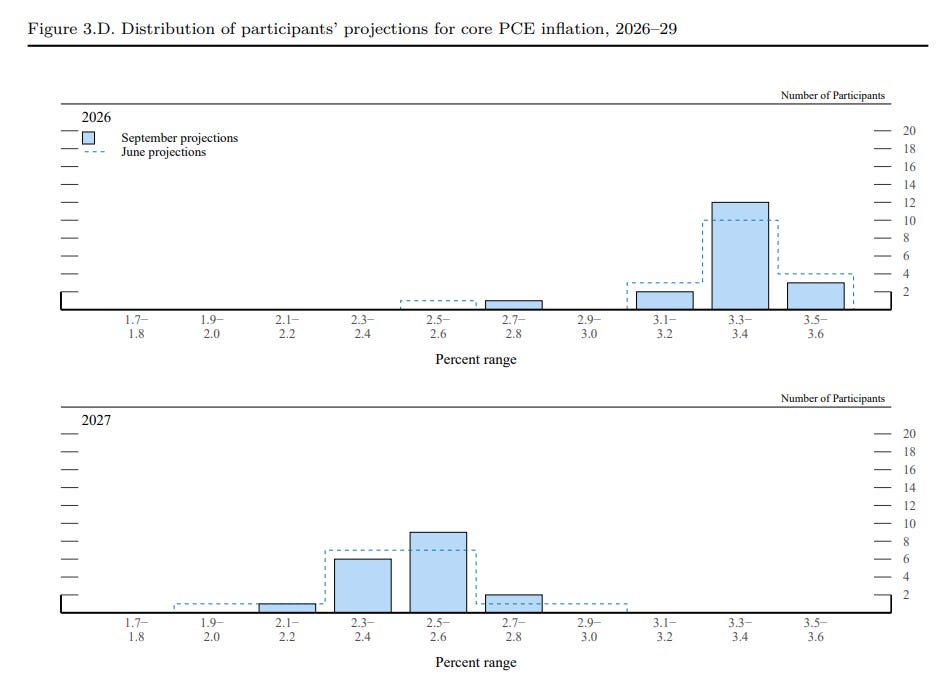
Core PCE for 2026 is expected to remain elevated in the 3.3-3.4% range. I should add an important caveat - the Bureau of Economic Analysis (BEA), which calculates the PCE will slightly modify their data inputs, which is expected to mechanically reduce the current PCE readings by around 0.1 to 0.2 percentage points. It does not appear that the participants took this into account when forming their projections.
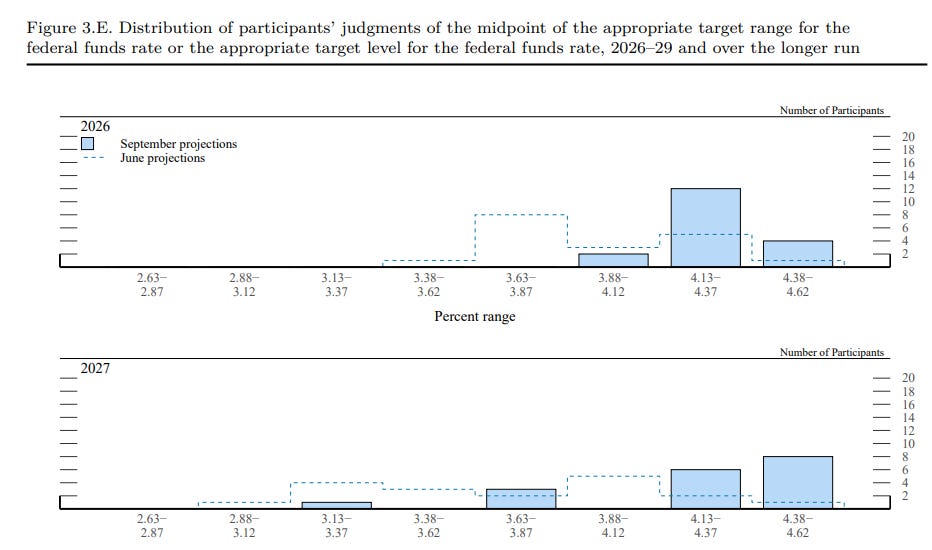
Below is the forecast for the interest rate:
Here is the same data, just in the more classical ‘dot plot’:
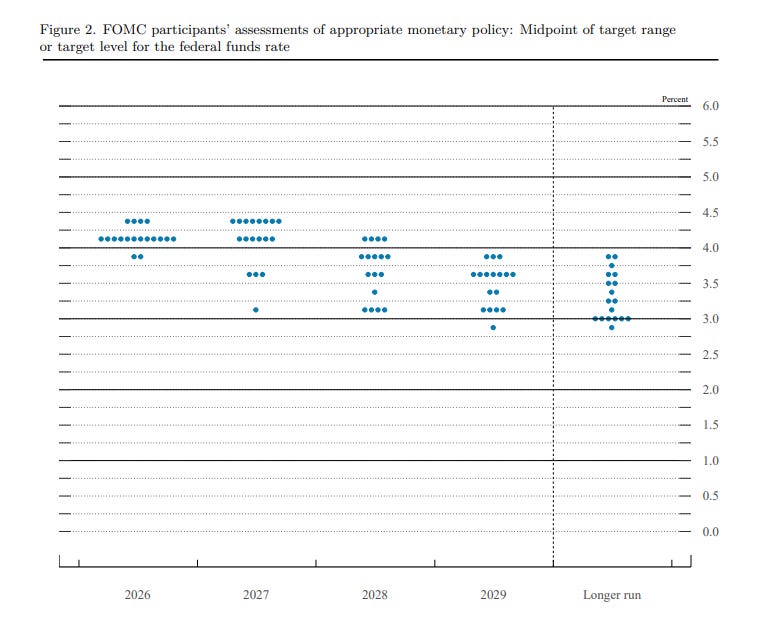
This is where things get interesting:
Most participants expect another hike in 2026!
Most participants expect high interest rates to remain elevated throughout all of 2027, with a real possibility of another rate hike in 2027.
I do not find this surprising - if we take a reasonable expectation for government policy in the next year, inflation will persist and we will need higher interest rates to bring it down.
One thing I do find puzzling in the forecasts is the disconnect between the inflation forecast for 2027 (at 2.5%) and the interest rate forecast (at over 4%). If inflation by the end of 2027 is at 2.5%, as measured by Core PCE, I believe rates will be lower - closer to 3.25%-3.5%. The disconnect is a bit puzzling to me.
Kevin Warsh Press Conference - Mostly Evasive Statements
The press conference by Federal Reserve Chair Kevin Warsh was, frankly, not very informative. In part, that’s what Warsh wants - he’s opposed to ‘forward guidance’ (explicitly stating future FOMC decisions). However, beyond avoiding forward guidance, Warsh was also cagey in explaining exactly why the current decision was made. Two things stood out to me - one encouraging and one concerning.
Oil Shock Comment
In response to the very question about the oil price shock stemming from the US-Iran conflict, Warsh mentioned that there is a danger that higher oil prices could spill-over to other prices. This is a real risk and it is reassuring to see the Fed taking it seriously. Here is a recent paper showing how supply shocks can feed into inflation expectations, much like they did during Covid.
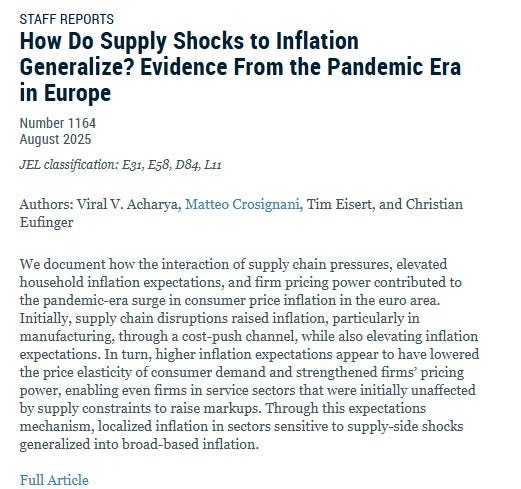
The basic argument of the paper is that general awareness of supply shock price increases (like those we’ve seen with energy) makes consumers less sensitive to price increase in general. This allows firms not directly impacted by supply shocks to raise prices.
Overall Economy Comment
In response to a question on what had broadly changed since the July meeting to prompt the rate hike, Warsh mentioned the following things in this order:
A strengthening US Economy
Inflation trends that were not passing the test
Geopolitics
I find this response concerning.
First - the US economy is not actually strengthening. Real GDP growth slowed from 2.1% in Q1 2026 to 1.5% in Q2 . These growth rates are lower than real GDP growth in 2024 (2.8%) and also in 2025 (2.1%).
The unemployment rate is similar to in 2024 at 4.1% and minimally lower than in 2025 (4.4%). Productivity growth was also low: 0.8% in the first quarter, and 1.4% in the second quarter, which are both below the long run average of 2.1%. Lastly, real wage growth has also fallen and is hovering near 0%.
None of these data points suggest a ‘strengthened’ US economy, as Kevin Warsh claimed.
Regarding inflation trends - I am also a bit surprised. Since July, it has been quite clear that inflation prints would remain elevated due to government policy choices. The inflation trend should have been anticipated by Warsh.
On the last point, what stands out is that geopolitics, along with the wider government policy, wasn’t mentioned as the first reason! Let me elaborate
Government Policies
Here is a chart of Core PCE inflation (the FOMC’s preferred interest rate measure).
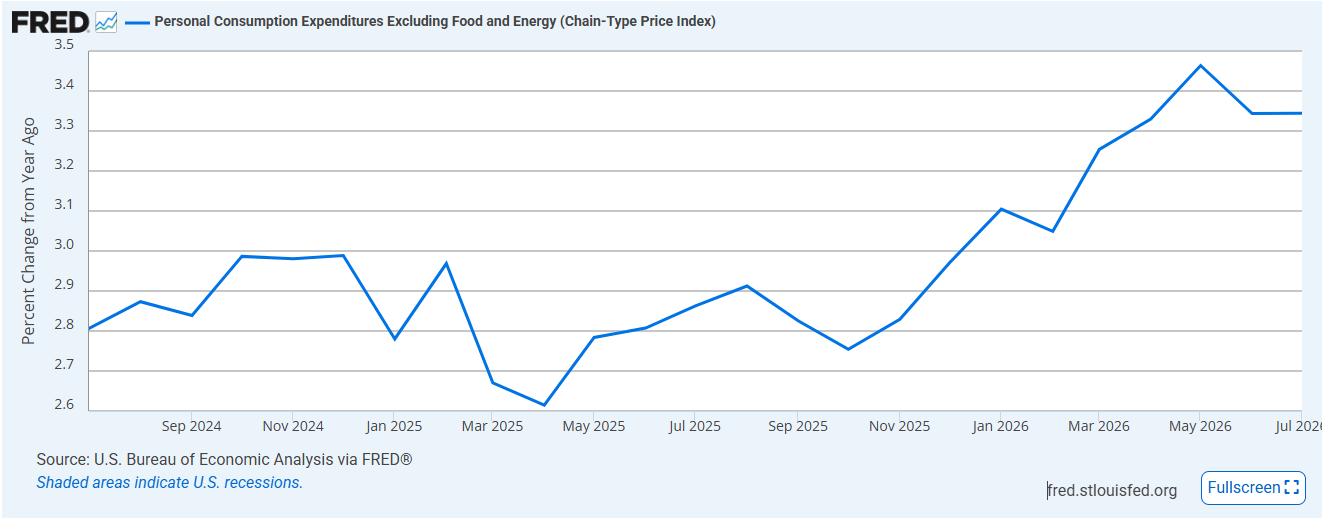
Core PCE was trending down and bottomed in April 2025 at 2.6%. Then came the first supply shock: the ‘liberation day’ tariffs enacted in April 2025. At the same time, the US government enacted a policy that significantly reduced all forms immigration, creating a second supply shock.
Then, in February 2026, the US struck Iran, which led to the oil shock - the third supply shock. In response to these three supply shocks, the FOMC in the period 2025 to 2026 did not raise interest rates (and actually cut interest rates twice near the end of 2025).
Because these supply shocks are all inflationary, while FOMC policy was accommodating, it shouldn’t be surprising that inflation started creeping back up. Deferring interest rate hikes could be justified if we believe the shocks are relatively short-lived. However, they clearly weren’t, justifying the hike today.
Where I Think Inflation and Interest Rates are Heading
With the above assessment in mind, I do not see any of these supply shock pressures subsiding. Tariff policy continues to be pushed and we haven’t seen all the tariff impacts on inflation (new autos is one such category). Immigration remains curtailed and the conflict in Iran appears to not be coming to a resolution.
These factors are all beyond the FOMC’s control, yet the Committee needs to react to them. One could argue that the FOMC should have increased interest rates by 50bps given they plan on increasing anyway. I wouldn’t have been surprised if at least one dissent would have been in favor of a double hike. My guess is that the Committee prefers a wait-and-see approach to how government policy develops.
Overall, my forecast is as follows:
If we see a meaningful government policy shift (e.g. reopening of the Hormuz strait), rates will be kept as they are now, with inflation expected to gradually fall by early 2027.
If current policies remain in place, one more interest rate hike, perhaps at the next meeting
If there is an escalation in either tariffs or the war, expect the upcoming 2026 hike, plus an additional hike in 2027.
Given these scenarios depend on political variables, I’ll let you decide which outcome is most likely.