


Nominal News is an economics newsletter written by a PhD Economist that translates the latest economic research into clear, policy‑relevant insights on current issues. Join 4,000 readers to stay-up-to-date with Nominal News directly in your inbox:
In almost any introductory economics class, ‘free’ trade is presented as a welfare-improving policy. However, in graduate economics classes, you learn that this increase in welfare is only certain in the long run. But what happens in the short-run? Here the picture gets murkier. Recently, a study by Finkelstein, Notowidigdo and Shi (2026) (“FNS”) and by Noghanibehambari and Fletcher (2026) (“NF”) looked at how the North American Free Trade Agreement (NAFTA) between the US, Mexico and Canada may have shortened lives of US manufacturing workers.

Opening Up to Trade
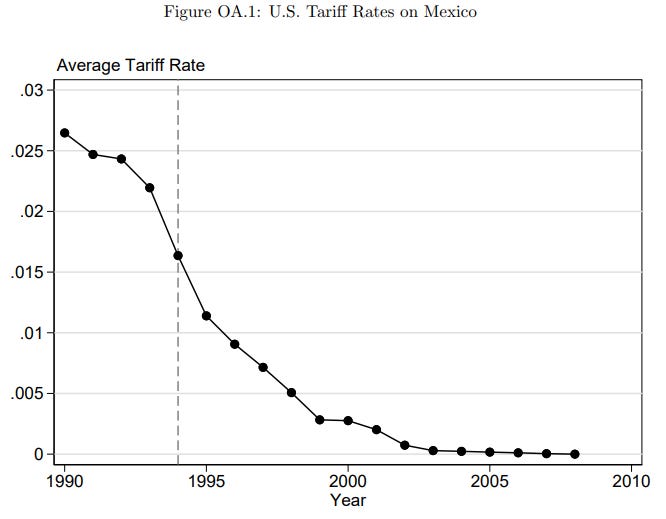
NAFTA, which removed tariff and non-tariff trade barriers between the US, Mexico and Canada, became law on January 1, 1994. NAFTA de facto created a single goods market that covered, at the time, 400 million people, and accounted for one third of the world’s output. The main impact of NAFTA was the removal of trade barriers between the US and Mexico (as Canadian-US trade barriers were effectively removed in 1987). Over 15 years, NAFTA reduced US tariffs on goods from Mexico from 2% to 0%:
The seminal paper by Caliendo and Parro (2015) found that the impacts of NAFTA on welfare were relatively muted – Mexico benefitted the most with a 1.3% increase in welfare, the US gained about 0.08%, while Canada saw a minor welfare decline of 0.06%. However, all countries saw an increase in real wages – i.e. workers were able to purchase more goods/services after the passing of NAFTA.
But the Caliendo and Parro paper looked at the question of trade liberalization mainly from a total income perspective. Since trade liberalization shocks may also impact workers’ well being in other ways, FNS and NF wanted to understand what happens to mortality after such a shock.
Concentrated Manufacturing Shock
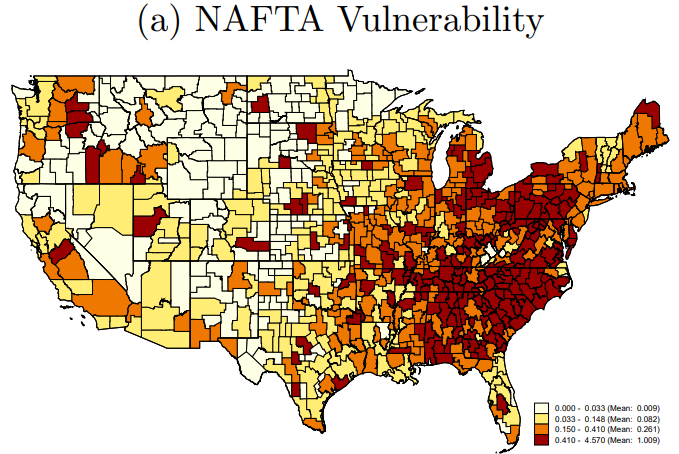
To determine how mortality changed due to the impact of NAFTA, both papers had to first determine which areas in the US were most ‘exposed’ to NAFTA. To measure this exposure (or vulnerability), economists looked at three key factors:
Whether the industry had a high share of imports from Mexico – this captures the fact that Mexico had a comparative advantage in this industry than in other industries;
The size of tariffs prior to NAFTA in the industry – a higher tariff would mean there would be greater competition from Mexican producers once the tariffs are removed;
The share of US workers in a given region working in the industries that are influenced by 1 and 2 – the more workers working in industries exposed to Mexican imports, the bigger the shock the region will face.
The map below from FNS shows which US regions were most vulnerable by quartiles (the darkest color being the most vulnerable):
Using the fact that regions had different exposures to NAFTA, FNS estimated how mortality responded to NAFTA. FNS found that average annual mortality increased by 0.68% over the period 1994 to 2008. To put into context, average annual mortality between 1965 and 2000 fell between 1% to 1.5% (Cutler and Meara, 2004). This means that NAFTA may have eroded half the improvements in mortality.
Mortality Increases Among Working Men and The Elderly
It is important to note that the 0.68% increase in mortality is an average. NF, using similar methodology in their paper, found that the mortality increase in the most NAFTA exposed areas was 4.2%. FNS broke out the increase in mortality and found two major groups accounted for a large share of the increase:
One-third of the increase in mortality was due to an increase in deaths of working age men, between 25 to 64 years old;
Half of the increase in mortality was driven by people aged 65 or more.
The mortality increase of working age men suggests that direct job loss/displacement may be the cause of overall increased mortality.
Regarding the increase in elderly mortality, a potential explanation is that adults over 65 may have depended on their children for financial assistance. Thus, when a worker lost a job during NAFTA, it may have also adversely impacted their parents/grandparents. FNS found evidence for this – over 60% of the increase in the mortality of the elderly was driven by increased mortality of elderly female widows, who often depend financially more on their children.
Did NAFTA Reduce Welfare?
FNS conducted a high level welfare analysis which, unlike previous research that focused predominantly on the income impacts of NAFTA, also included the mortality impacts they estimated. As noted previously, prior estimates of NAFTA showed a 0.08% welfare increase in the US. FNS estimated that including the mortality impacts, US welfare most likely fell – the reduction in welfare due to NAFTA was around 0.11% to 0.69% (depending on assumptions).
But, there are certain caveats around this conclusion that need to be taken into account.
Understanding the Econometrics of the Estimation Method
FNS point out that their estimation relies on looking at differences in mortality between regions – that is, how did mortality change in a region that was more exposed to NAFTA compared to a region that was less exposed. In effect, we are looking at a difference, and in simple terms we have the following problem: If previously, we had a difference of 3 (for example, one group was 10 and the other group was 7, giving a difference of 3), and now we have a difference of 4, we could have two causes for it:
One group went up by 1 – so 11-7 = 4; or
One group went down by 1 – so 10-6 = 4.
(A mix of both is also possible). In our context, this means that the observed increase in mortality could be driven in part by the fact that mortality for non-NAFTA exposed individuals decreased thanks to NAFTA.
However, looking at other studies, FNS argue that it is very unlikely that mortality for non-NAFTA exposed individuals reduced meaningfully. Most studies find that income increases have no impact or, surprisingly, a negative impact on mortality. Thus, in my opinion, it does appear that NAFTA did increase mortality of vulnerable workers.
Uniqueness of Trade Shocks
The adverse impacts of NAFTA on mortality appear to be driven by job loss/displacement. One could expect that job loss would always increase mortality. Surprisingly, economists have found that during recessions, when job losses may even be greater, mortality falls (Ariizumi and Schirle, 2012). FNS confirmed this by looking at the impact of the 2008 Great Recession on mortality. They found that mortality reduced in areas more exposed to the adverse impacts of the Great Recession. But, trade shocks like NAFTA or China joining the World Trade Organization in 2001, increase mortality.
The reason behind these different mortality outcomes to what appear to be similar shocks is a bit of a puzzle. One proposed answer is that trade shocks adversely impact jobs that are unionized, which typically have higher wages and other benefits. FNS found that regions with higher unionization rates did exhibit larger mortality increases due to NAFTA. This is suggestive evidence for that hypothesis.
Can We Better Redistribute the Gains of Trade?
The research by FNS and NF shows that trade shocks like NAFTA do have strong negative impacts on a concentrated group of people exposed to these shocks. Are there ways to mitigate this issue?
Providing Cash/In-Kind Transfers
One solution might be to offer income support to workers that are exposed to job loss from trade shocks. However, studies by Chorniy, Finkelstein and Notowidigdo (2025), as well as Evans and Moore (2012), have found that such cash transfers increase mortality, often caused by alcohol or drug abuse. In-kind transfers, like food vouchers, appear to not increase mortality. Just giving cash may not be sufficient to alleviate the negative consequences.
As mentioned earlier, there was a significant increase in mortality among the elderly that may have been driven by reduced financial support from their children laid off from their jobs. Although exacerbated by trade shocks, assisting the elderly should be addressable by policy, whether through better design of social insurance or more direct financial assistance.
Key Takeaways
The FNS and NF research has three key takeaways – one for economists/researchers and two for policy designers.
For economists:
The impacts of trade liberalization on individuals is very varied in the short run. Typically, as economists, we have looked at trade liberalization from a long run perspective which showed unambiguous long run benefits. However, a lot of the adverse impacts occur during the transition phase of opening up to trade, concentrated on a narrow group. The focus on the transition is crucial to understand the consequences of trade liberalization, as well as informing the design of better economic policy.
For Policy Makers:
Alleviating the negative impacts of the trade shock is important, as certain groups face the brunt of negative consequences. This may entail redistributing via taxes into in-kind transfers, as well as more broad outreach to communities that may see the negative consequences.
Tariffs and trade protection, especially after trade liberalization already occurred, may result in the amplification of the negative outcomes from trade liberalization. Attempting to protect an industry from foreign competition via tariffs may inadvertently incentivize workers to enter the industry. Once the tariffs disappear (or foreign competitors get even better), a similar trade shock to the NAFTA shock may occur again, resulting in a mortality rate jump. Thus, ‘closing’ to trade will not undo the negative impacts of opening to trade, but will likely repeat them.
If you would like to support us in reaching our subscriber goal of 7,000 subscribers, please consider sharing this article and pressing the like❤️ button at top or bottom of this article!
Interesting Reads from the Week
When People Cut Back on Instagram, Where Do They Go? – Jadrian Wooten discusses a recent research experiment on how people use the time freed up by turning off Facebook and Instagram.
Reflections on Vibe Researching – Joshua Gans talks about using AI for research. This paragraph summarizes it very well:
My point is that the experiment – can we do research at high speed without much human input – was a failure. And it wasn’t just a failure because LLMs aren’t yet good enough. I think that even if LLMs improve greatly, the human taste or judgment in research is still incredibly important, and I saw nothing over the course of the year to suggest that LLMs were able to encroach on that advantage. They could be of great help and certainly make research a ton more fun, but there is something in the judgment that comes from research experience, the judgment of my peers and the importance of letting research gestate that seems more immutable to me than ever.
Short Note from me:
You write "depending on assumptions" as a kind of throw-away, but it is a cover for the entire issue -- what kind of assumptions were made, and how much do they affect the outcome, and how solidly are they based on valid (not merely in agreement) evidence)? We continuously see these problems arise n studies produced by "think tanks" of Right AND Left that turn out studies that miraculously always only support the predetermined opinions of the authors. It is a HUGE problem in economics, which is supposed to be "objective", and we paper over the evidential gulf with meaningless terms like "normative economics".
As I am sure we all know, Case and Deaton made a strong case for an increase of deaths via drugs (especially opioids), alcohol and suicide in the period covered by this study. It is not unrealistic to suspect that there was some effect having to do with NAFTA, and, even better, globalization generally, including China. That said, there was also a major change in attitudes toward Blacks and women during that period, now apparently being reversed by the current Administration -- such cultural changes also surely had an effect on White men's self-esteem. Why is it that those whose jobs were lost were slow to take new jobs, train for new industries, move to new locations, as economists at the time thought they would? How can this be increased? I argue in my classes that the US is quite low on the scale of OECD countries in terms of their support for funding for transitional career training of workers affected by changes in patterns of trade. Instead of focusing on the negative effects of changing trade patterns, if we consider that comparative advantage really is beneficial we should put our money where our mouths are, and promote mitigation of the negative effects by prudent policies supporting expansion of those trades that are expanding, especially services -- that would help everyone.