


Nominal News is an economics newsletter written by a PhD Economist that translates the latest economic research into clear, policy‑relevant insights on current issues. Join 4,000 readers to stay-up-to-date with Nominal News directly in your inbox:
Going forward, special edition articles will be accessible to paid tier subscribers. My next special edition article will be covering the FOMC meeting and press conference on September 16. Subscriptions will go live September 8. If you’d like to enter a chance for a free 3-month paid subscription, please fill out my questionnaire.
US Treasury Secretary Scott Bessent announced on August 19, 2026 that the US Treasury will boost buybacks of US treasury bonds with maturities between 10 years to 30 years. The US Treasury is expected to buy up to $4bln worth of bonds per transaction, 4 times a quarter. So what does it mean?

Rising Yields – i.e. Rising Interest Rates
The US has been experiencing a rise in yields on long-dated bonds. A yield can be thought of as the interest rate an investor would require to earn in order to buy the bond. Below is the yield of a 30-Year US Treasuries over the last 5 years:
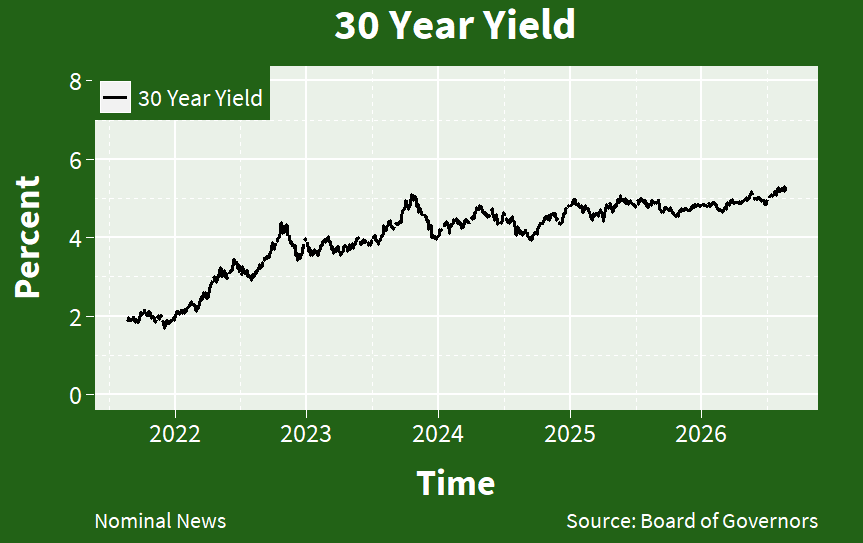
Higher yields mean that when the government issues new 30 Year Treasuries (government debt), it will have to offer the yield as a fixed interest rate for the duration of the bond. This means issuing debt for the government has gotten more costly over the last 5 years.
At the same time, US Treasuries are often used as a baseline cost of debt for other markets. For example, the 10-Year Treasury is often relied upon to set interest rates for home mortgages. Other investments also rely on this as a benchmark.
This recent increase in yields and persistently higher yields appears to have concerned the government, which has been calling for lower interest rates for a while. The buyback initiated by the US Treasury appears to have been motivated by the desire to lower interest rates.
Buybacks – Balancing the Yield Curves
By buying back long-dated bonds, the yield on these bonds fall.1 In exchange, the US Treasury issues short-dated bonds (for example, 2-Year bonds), which have a lower yield than the long-dated bonds. This action does increase the yield of these short-dated bonds. In the end, the difference between yields of 2-Year bonds and 10-Year bonds shrinks.
Why Do This?
One potential reason to do such an operation is if the government believes the market is mis-pricing the bond. That is, if long-dated bonds have yields that are too high compared to what they think they should be, it might make sense to briefly issue more short-dated bonds, until the yields on long-dated bonds adjust.
However, this presumes that there’s a reasonable chance these long-dated yields will drop in the foreseeable future.
What Happened After The Buyback?
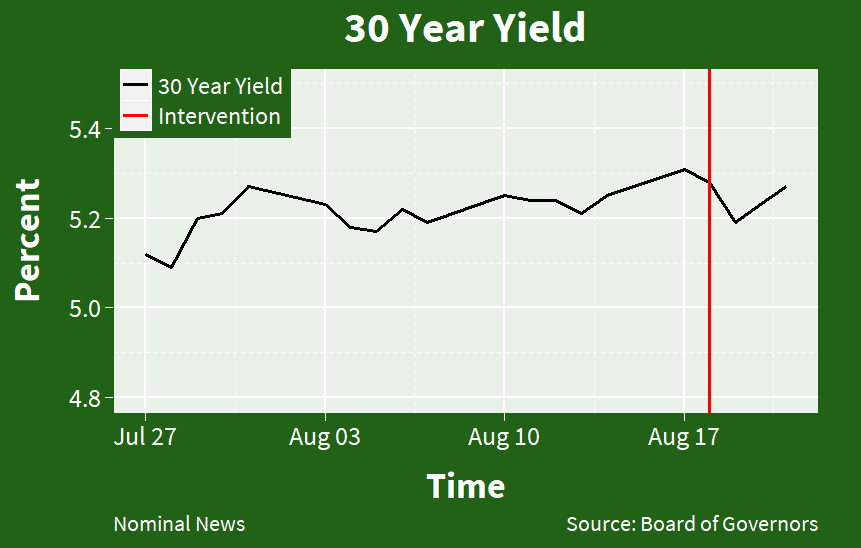
Right after the announcement, the 30-Year bond yields fell. But – yields quickly rebounded in a few days, as can be seen from the chart below (the red line being the day prior to the announcement)
What “Went Wrong”?
First, the amount of bonds being bought back is quite low, which is insufficient to truly move the market. Second, more importantly, the market disagrees with the US Treasury’s perception that the bonds are mis-priced. The yields, which are driven heavily by the Federal Reserve Interest Rate, are expected to be elevated until inflation is brought down. Basically, because inflation is expected to be higher for longer (due to multiple other government policies – tariffs, anti-immigration, war), interest rates are expected to be higher for longer as well.
In turn, investors demand higher interest rates (yields) to hold long-dated government debt. That’s because the yield of long-date bonds has to equal the yields of a sequence of short-dated bonds (the interest earned on a 30 Year bond should equal the interest earned on a 2 Year bond that’s renewed 15 times in the future).
A Unique Intervention
The US government buying back Treasuries is a relatively rare phenomenon. The most recent large buyback occurred in the 2000 to 2002 period, when $67.5bln of bonds were bought back. At the time, the outstanding debt was around $5.6trln, meaning around 1% of bonds were bought back. A recent paper by Connolly and Struby (2024) (“CS”) investigated that episode and found that the impact of the buyback was noticeable – yields in the bonds that were bought back fell by about 0.95%.
The current Treasury buyback policy, which started around 2023, is of a much lower scale. For it to be comparable to the 2000-2002 episode, around $400bln worth of bonds need to be bought (compared to the current $16bln per quarter buyback cap). CS, in their paper, actually discussed this specific buyback policy (prior to the announced increase) and found that the impact on yields will be zero. Which is basically what happened.
This new policy is unlikely to ‘fix’ what Scott Bessent thinks is the problem. Realistically, yields on long-dated bonds will only fall if the government enacts policies that reduce inflation. This includes ending the tariffs, easing immigration and ending the war. His government right now, however, appears to not be willing to do that. More concerningly, the government appears to not realize that these other factors are the problem.
If you would like to support us in reaching our subscriber goal of 7,000 subscribers, please consider sharing this article and pressing the like❤️ button at top or bottom of this article!
The price of a bond and the yield are inversely related. By buying bonds, the price of them goes up, which pushes the yield down. To illustrate this relationship with an example – suppose you have a bond that has a price of $100 and offers a $5 coupon payment each year. This bond would have a 5% yield ($5/$100). Suppose now the price of the bond falls to $50. Since the coupon is the same, at $5, the yield is now $5/$50, which is 10%.
Isn’t this circular financing? Just like the AI tech companies.
People joke that the Fed is the money printing machine while this time it is the treasury