


Nominal News is an economics newsletter written by a PhD Economist that translates the latest economic research into clear, policy‑relevant insights on current issues. Join 4,000 readers to stay-up-to-date with Nominal News directly in your inbox:
On April 2, 2025, the US announced the “liberation day” tariffs which raised tariffs on all imports by at least 10%.1 One year later, the latest research shows that economists’ original estimates of the impacts of tariffs were pretty accurate – the tariffs were almost entirely paid by US taxpayers, inflation readings were elevated, while overall economic output was slightly reduced.

Tariff Pass-Through To US Consumers
One common argument made by tariff proponents is that the tariff – or tax on imports – will be effectively paid by foreign countries, specifically foreign exporters. Gopinath and Neiman (2026) (“GN”) looked at the 2019 tariffs and 2025 tariffs and found that the cost of the tariffs is nearly entirely borne by the American consumer.
First, GN show that the actual paid tariffs, or effective tariff rate (blue lines), are much lower than the statutory ones (red lines) established:
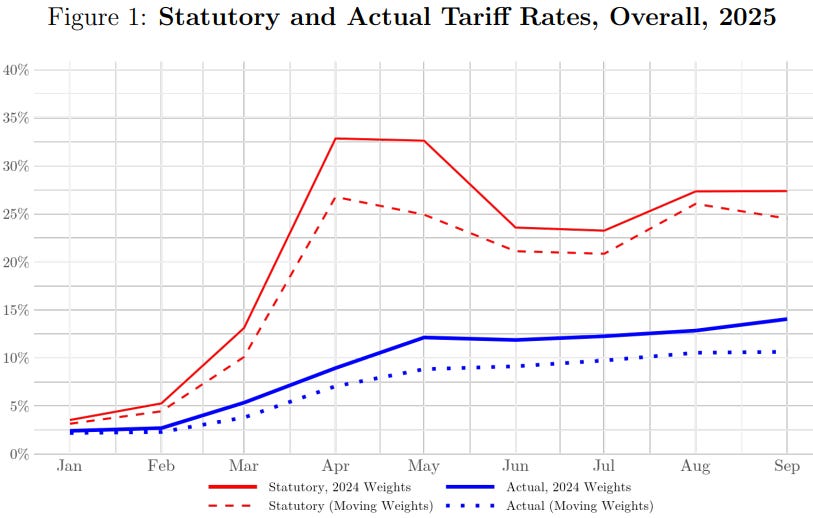
There are several reasons for the discrepancy between statutory and actual tariffs:
Shipment lags – goods that were in transit when the tariffs were announced were exempts from tariffs;
The existence of multiple product exemptions, as well as exemptions for specific companies;
Utilizing the USMCA exemption – the USMCA trade agreement between USA, Mexico and Canada, allows for tariff-free trade if a sufficient amount of the value of the goods is made in Canada or Mexico.
Using the actual tariffs, GN found that for the ten sectors with the largest increases in tariffs, the tariff pass-through to consumers ranged from 90% to 114%. Interestingly, this shows that in some sectors, tariffs resulted in price increases that went beyond the tariff size. A look at how tariffs impact the entire goods supply chain can help explain how this happens.
Tariffs and the Supply Chain
Flaaen, Hortaçsu, Tintelnot, Urdaneta and Xu (2025) (“FHTUX”) studied how tariffs on European wines fed through the US wine supply chain. FHTUX tracked the price of wine from the foreigner producer, to the importer, distributor, retailer and ultimately, the consumer. The US wine market is particularly well-suited for this type of analysis, as, by law, producers/importers cannot legally be distributors, and distributors cannot be retailers. This legal separation means that the prices set in each stage of the supply chain were market prices negotiated at arm’s length.
FHTUX found the following price response to a 25% US tariff levied on wine:
Foreign wine producers reduced their prices by 5.2%;
US importers increased their prices charged to distributors by 5.4%;
US consumers ultimately paid a 6.9% higher price.
Now, although the percentage pass-through might be incomplete (i.e. prices didn’t go up by 25%), the pass-through in dollars exceeds the dollar amount of the tariff. For a wine bottle the importer paid $5, after the wine goes through the supply chain to the retailer, the 25% tariff results in the US consumer paying $1.59 more, while the tariff due was $1.19!
FHTUX tells us that many commonly mentioned narratives can be true at the same time:
Foreign producers do ‘pay’ some of the tariffs as they reduced their prices;
US consumers also pay the entire tariff (and more!).
Broader Array of Goods
Hinz, Lohmann, Mahlkow and Vorwig (2026) (“HLMV”) looked at a global shipping data set that provides daily price and quantity data on maritime shipments. HLMV observed over 25 million product shipments and were able to extract unit prices – value per kilogram of goods transported. In response to tariffs, HLMV found a near complete pass-through of tariffs – that is, foreign exporters did not reduce prices at all (at most the estimate is a 4% price reduction, although this was not statistically significant).2
Bulk Discounts
Ganapati and Hottman (2026) (“GH”) also looked at price pass-through but took bulk pricing into account. Typically when ordering more of a good, producers offer lower prices per unit. Thus, if the amount ordered is lower than before, one could expect the price per unit to go up. Since tariffs increase prices of imported goods, importers order fewer goods, which in turn should result in the producer/exporter charging a higher price. Therefore, if the producers do not charge a higher amount per unit, that would imply that the producer is ‘paying’ some of the tariff.
By taking this ‘bulk discount’ factor into account, GH find that the estimated tariff pass-through to US consumers is approximately 60%. GH show that if we do not take into account the potential for ‘bulk discounts’, the estimated tariff pass-through is 100%, as found by other studies. This suggests that taking into account order volume may matter.
I would, however, caution about the ‘bulk discount’ assumption, as currently, exporters may be keeping similar unit prices as part of long term deals or even as a strategy to maintain relationships with importers under the assumption that the tariffs may be rescinded in the near future. Thus, if exporters believed that the tariffs were a permanent policy for many years, these exporters perhaps would have increased prices given the lower order volume.
Broad Economic Impacts
The research above demonstrates that tariff pass-through to US consumers has been largely complete. So how has it impacted macroeconomic factors?
Tariffs and Inflation
As tariffs have increased prices, it should come as no surprise that inflation in the US has ticked up. Research by Cavallo, Llamas and Vazquez (2026), (“CLV”) continues to show a steady increase in observed inflation in tariffed goods (imported, yellow line).
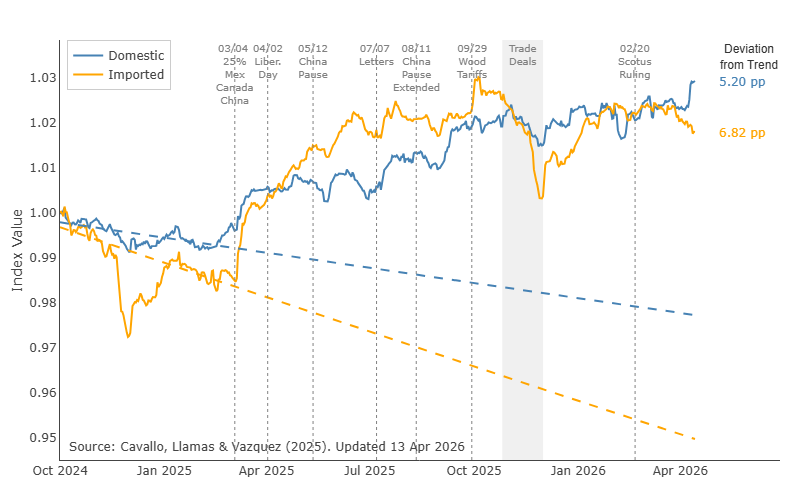
More importantly, non-tariffed goods (domestic) also see a rise in inflation. This is not a surprise – inflation always spills over to other sectors and it’s really only the magnitude of the spillover that’s the question. In the goods sector, it appears the tariff spill-over on domestic good prices (blue line) has been just as large as the impact on prices of imported goods (domestic goods saw a price increase by 5.2 percentage points compared to 6.8 percentage points for imported goods).
Although we have predominantly seen goods sector inflation increases, there is, or will be, also some spillover to the service sector. This is due to the fact that physical goods are an input to services (e.g. food is an input for restaurants), and because workers will also demand higher nominal wages to offset the fact that the basket of items they purchase for personal consumption is now more expensive. The magnitude of this spillover into services may end up being small but it almost certainly exists nonetheless. CLV estimate that so far, tariffs have contributed almost 1 full percentage point to US inflation (which is currently at 3.3%). Absent tariffs, inflation would have been very close to the 2% inflation target set by the Federal Reserve.
Tariffs and US Economy
Beyond inflation, tariffs can also be expected to impact the wider economy. For this, we turn to the Fajgeballum and Khandelwal (2026) (“FG”) model. First, a few key inputs – FG estimated the effective tariff rate to be 9.6% (recall that effective rates may be much lower than officially stated ones) with a 90% tariff pass-through (this estimate is perhaps on the low side compared to other studies).
FG find very interesting results – the overall impact on welfare in the US is extremely negligible with a 0.13% reduction in welfare measured in GDP terms – the reduction in welfare (happiness) is equivalent to having GDP lower by 0.13%.
But this lower overall welfare reduction hides the fact that impact is very uneven:
Consumers lose out by about 2.6%;
Domestic produces gain around 1.4%, as they receive higher prices;
The government gains around 1.1% due to tariff revenue.
Real wages also fall, particularly for workers in goods-producing sectors like manufacturing. This is because many of the tariffed goods are inputs into US manufacturing, making manufacturing in the US more costly, which in turn reduces employment and pushes real wages lower in these sectors.
The Tariff Experiment – A Predictable Failure
This recent batch of research quite unambiguously shows that tariffs have been a bad policy for the US.
Tariffs:
raised inflation;
reduced output and welfare;
reduced real wages.
Moreover, although the aggregate effect of tariffs on the US may be small, the impact has been uneven – consumers and workers lost out, while domestic producers benefited from the tariff policy. Additionally, after the tariffs were deemed ‘illegal’, US importing firms will be able to claim a tariff refund, meaning that the US taxpayer/consumer will be even worse off, as government revenues fall!
The research discussed today also shows how tariff-proponents may be very selective with data – for example, they may highlight that foreign producers may reduce prices slightly in response to tariffs, but conveniently omit that other participants in the supply chain can use tariffs as a reason to increase prices by even more than the tariff cost.
Overall, the fact that we have to write this article is a bit unfortunate – most of economics research has effectively shown that tariffs could not have a positive impact on the US economy, and undertaking this ‘experiment’ in 2025 was not worth it.
If you would like to support us in reaching our subscriber goal of 7,000 subscribers, please consider sharing this article and pressing the like❤️ button at top or bottom of this article!
Interesting Reads from the Week
Are People Happier When They Buy Experiences? – Erman Misirlisoy, PhD discusses research showing that how we define what is materialistic or experiential is impacted by our own well-being.
AI May, Paradoxically, Increase Demand for Higher Ed – Jimmy Alfonso Licon talks about how AI may increase demand for higher education, although it may require institutions to re-organize a bit.
Estimating the Impact of Trump’s Policies on Consumers – Ryan Cummings, Jared Bernstein, Neale Mahoney and Caleb Brobst estimate that the average household is expected to lose more than $1,100 this year due to Trump’s policy choices, with bigger losses for low income households!
The actual realized tariffs were a bit more complex, as many prior trade agreements prevented the enactment of tariffs on certain countries.
Trade volumes may have fallen, although these results were not statistically significant.
Great analysis
This is what we all predicted would happen.
Now, it’s worth noting that these tariffs have not triggered a recession (yet), but remember the tariffs actually implemented on “Liberation Day” were lower than originally planned and carried many additional exemptions.
For example, 70 percent of American imports were covered under illegal IEEPA taxes. The administration then slowly added exemptions, including consumer electronics, bullion, minerals, and agricultural products.
Now, under section 122, the exemptions are broader still, and therefore these taxes only apply to about 40 percent of American imports.
If the goal is to re-industrialize America, tariffs are the wrong policy tool.
"consumers and workers lost out, while domestic producers benefited from the tariff policy."
Since domestic producers are also consumers of various goods, do they really benefit? Besides being consumers, they may also be employers and you explained that salaries will also go up due to higher cost of goods.
I am not convinced anyone benefits!