


Thank you for reading our work! Nominal News is an email newsletter read by over 4,000 readers that focuses on the application of economic research on current issues. Subscribe for free to stay-up-to-date with Nominal News directly in your inbox:
If you would like to support us in reaching our subscriber goal of 10,000 subscribers, please consider sharing this article and pressing the like❤️ button at top or bottom of this article!
Note from Nominal News
Wishing all our readers a Happy Holiday period and thank you for supporting our Substack! Next week we will do a New Year special, recapping our year.
Every year around the holidays, the paper by Joel Waldfogel (1993) on the inefficiency of gift giving gets widely circulated in social media and the news (Wired, New Republic, Marginal Revolution, WSJ). Waldfogel, using survey data from a wealthy college, determined that people value the gifts they received between 10% to 33% below the price of the gift. This finding implied that gift-giving is ‘inefficient’ and value destroying.
But a follow-up series of papers with much more sophisticated methods, showed that gift giving actually generates positive value! This suggests that the original Waldfogel paper was most likely influenced by a biased sample (wealthy college students that took economics). If you’d like to read about this research, we’ve covered these papers here:

Interestingly, in addition to the value of gift-giving between friends and family, it appears that gifts from employers, rather than cash bonuses, also influence workers positively as well.

Gifts in the Workplace
Kube, Maréchal and Puppe (2012) (“KMP”) looked at how gift giving to employees impacts worker productivity. KMP recruited workers to a one off task of cataloging books for a library for 3 hours. The job paid 12 Euros (~ 14 USD) per hour. The outcome KMP were measuring was how many text characters were entered in the online catalog. The workers did not know that their work was being measured as part of an experiment.
As part of the experiment, KMP tested out giving ‘unexpected’ bonuses to the workers. Prior to starting the work, different groups of workers in separate work sessions were each told the following:
They will earn just 12 Euros per hour (no bonus was announced);
In addition to the 12 Euros per hour, the workers will be paid a 7 Euro bonus (20% of total income), which was given to the workers at the start of the work sessions;
In addition to the 12 Euros per hour, the workers will receive a 7 Euro water bottle, which was given at the start of the work session.
In theory, being given option 2 (cash) and option 3 (water bottle) should have the same impact on workers. Option 2 may even be preferred. Surprisingly, KMP found the opposite – people that received a cash bonus did not have any statistically significant increase in output, while people that received the bottle entered nearly 25% more characters!
To study this puzzling behavior and rule out any other potential explanations, KMP, in a follow-up experiment, made sure that the 7 Euro price tag on the bottle was visible, in case workers thought the bottle was more valuable than it really was. Just as with the group that received the bottle without the price tag, this group of workers that received the bottle with the price tag also ended up being 20-25% more productive than the group that received the cash.
A Choice of Gifts
To see whether the gift (the bottle) was really seen as a valuable item, KMP conducted another experiment. Workers, prior to starting the work, were told that as a bonus, they can choose either to receive 7 Euros in cash or the bottle worth 7 Euros. Nearly unanimously, workers chose the cash. Interestingly, unlike in the cash only bonus scenario, workers were again 25% more productive. Thus, although the workers did not really value the bottle since they chose cash, the idea that the employer had prepared a physical gift appears to have influenced the workers. This led to one final experiment.
Origami Money
KMP gave one session of workers just the 7 Euro bonus at the start of the work session with a slight twist – the 5 Euro bill was folded into an origami shirt, while the 2 Euro coin had a smiley face drawn on it.
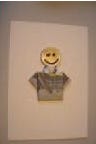
It turned out that the workers ended up again being 25% more productive compared to the baseline of no bonus, and 23% more productive compared to the situation where just money was given:
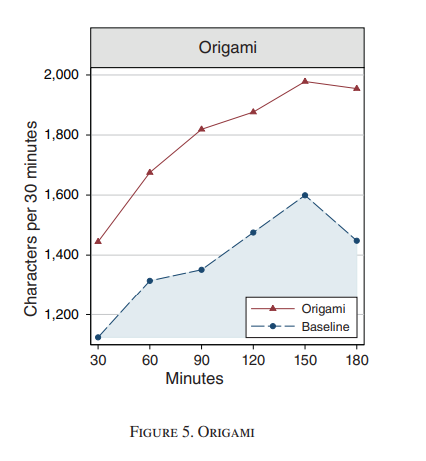
As the chart above shows, the rate of character entry was higher throughout the duration of the work session (the blue line is the baseline with no bonus). So how can we explain all these findings?
Gifts – Value Creating
Based on the KMP research, employees appear to value when their employer puts in time and effort when giving a bonus. These employees may reciprocate this employer effort – in the case of the KMP experiments, employees increase output by more than the bonus (25% more productive, while their income only went up by 20%). Even presenting cash in a more ‘artistic’ way appears to signal effort and care from the employer, which alters workers’ attitudes.
This result is in stark contrast to the conclusions from Waldfogel’s research – if employers were to follow that advice and just give cash , the output generated would be lower than if employers followed the intuitive tradition of giving gifts. Unlike the news articles we often see, gift giving is actually ‘efficient’. Regardless, KMP shows that gift-giving is a far more complex economic question than many present it to be.
Interesting Reads from the Week
Article: Mike Konczal discusses how the current US policies are panning out, and why, as expected by economists, the policies did not achieve the goals they were intended for.
Article: Sebastian Galiani argues why, in economics, we need both statistical methods and models to properly answer economic questions.
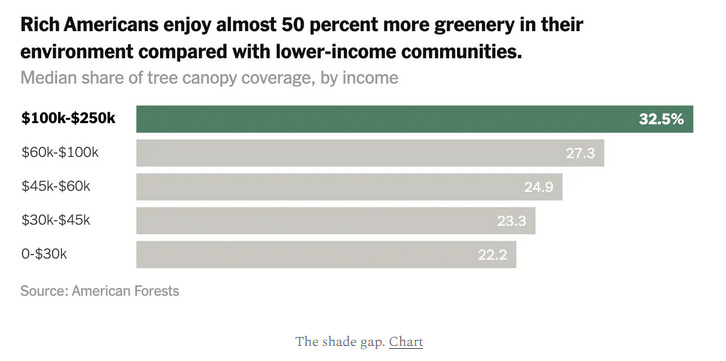
Article: Jeremy Ney and Michael Tiede talk about ‘tree inequality’ in the US. From their article, the chart below shows how greenery differs between neighborhoods of different incomes. This also translates into higher ambient street temperatures for neighborhoods with fewer trees.
we love exchanging gifts at work. we do this at christmas, easter, and sometimes on thanksgiving. but we also organize a gift for someone if it’s their birthday. i recently found the blidz customer service phone number ( https://blidz.pissedconsumer.com/customer-service.html ), and i think i already know what we’ll give to the next colleague for whom it’s really hard to guess a gift. do you think a gift card is a good present? personally, i would be happy if someone gave me something like that.
The right kind of gift(s) is appreciated. My small team does a little exchange. A+!
The multiple company pizza parties / cookie swaps. GTFOH.