


Nominal News is an economics newsletter written by a PhD Economist that translates the latest economic research into clear, policy‑relevant insights on current issues. Join 4,000 readers to stay-up-to-date with Nominal News directly in your inbox:
NEW! Podcast
Note to subscribers: we have officially launched a companion audio/podcast to our articles, which you can click to listen below. The companion audio talks about the topic I wrote about below, covering the article itself, but also discussing additional research that did not make it into the piece, as well as my opinion on the issue. Future companion audio/podcasts will be for Paid Subscribers, but is free for this article. We’re still running our 40% off launch special for a Paid Subscription!
College education is known to increase wages and earnings. The college wage premium – how much more one earns with a college degree over the earnings of someone with only a high-school degree – is quite large at 70%-80%, as shown here by Bengali, Sander, Valletta and Zhao (2023).
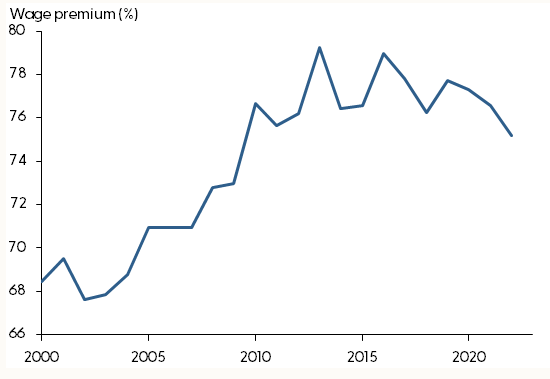
However, the exact cause of the college wage premium is hotly debated. Two main theories for the college wage premium have been proposed:
Completing college is a ‘signal’ that a person is highly capable;
College improves one’s abilities, making them more productive.

Waste of Time or Upskilling?
Under the ‘signalling’ theory, getting a college degree does not increase skills. However, since getting a college degree might not be easy (entrance exams and completing all coursework requires work), a person that successfully gets a degree can be assumed to have more ‘ability’ and therefore is more productive. If the person is more productive, firms are more interested in hiring this person and are also willing to pay a higher wage to this person.
Thus, under the ‘signalling’ theory, college merely serves as proof of one’s abilities that they already had. If there was another way we could observe a person’s ability, then college would become obsolete.
Contrary to ‘signalling’, the second theory proposes that college improves a person’s ability. Thus, after completing the degree, the person is more capable and more productive. Firms notice this higher productivity, and pay workers with college degrees more. Without a college degree, the worker would have a lower ability and thus, would not be as productive for the firm, which in turn means the firm would pay the worker less.
Changing College Requirements
Determining which theory is more likely to be correct is not easy. The reason for this is that we cannot observe the same person both getting a college degree and not getting one to determine how their wage would have developed. Occasionally, economists get lucky when a ‘natural’ experiment occurs.1
Arteaga (2018) used a change in the curriculum at Universidad de Los Andes, the top university in Colombia. In 2006, Los Andes decreased the required number of courses required to receive an economics degree by 12, and a business degree by 6. Additionally, the duration of college fell from 4.5 years to 4 years.
If after this change, there is no impact on wages, then it suggests that college acts more as a ‘signal’ (or at least additional coursework has limited value). But before we reveal the answer, let’s discuss whether this ‘natural’ experiment is valid.
The Experiment
The main idea behind the experiment is to compare the wages of graduates who had to do more coursework to get their degree, to individuals who had to do less coursework after the 2006 policy change. In order for this to be an appropriate comparison, the pre-2006 students and the post-2006 students have to be similar. For example, the change in policy should not result in students with very different abilities applying to Los Andes. If that were the case, then the comparison would be useless, as you would be comparing apples to oranges.
Arteaga looked at the characteristics of the Los Andes cohorts pre and post reform. There were:
No differences in the number of students entering the economics and business programs;
No difference in the test scores between the pre and post cohorts;
No difference in the graduate rates.
The first two bullet points suggest that the ability of students entering Los Andes did not change after the reform. The last bullet point tells us that the same number of students graduated after the reform. The reason this is important is if there were an increase/decrease in the number of graduating students, the signal of being a graduate might change (for example, if more students graduate, then the signal of graduating might be weaker).
Given there are no differences in cohorts, any changes in wages after graduation can be attributed to the fact that there is less learning at Los Andes.
Results
In order to control for any wider market changes in wages, Arteaga compared the wages of Los Andes economics and business students to the wages of graduates from other top 10 Colombian institutions. The results were striking:
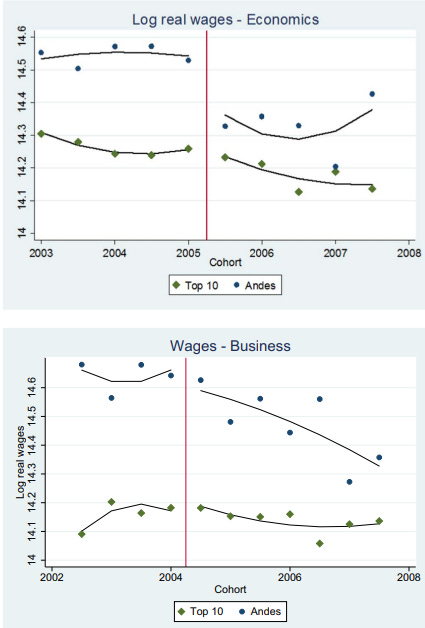
The chart shows the mean wages of each cohort. Prior to the change in policy (red line), wages for economics graduates from Los Andes were 36% higher than from other top 10 schools, while for business graduates, they were 50% higher. Post-reform, the Los Andes wages fell by 16% for economics students and 13% for business students.
One of my first concerns about the result was that, maybe due to the fact that the program is a semester shorter, the graduating cohort is younger and firms may value older people with higher life experience. Arteaga, however, ran the analysis controlling for age and found no change in the ultimate result.
Lastly, maybe there were some other changes at Los Andes that resulted in this dramatic wage fall. Arteaga conducted an identical analysis for law students at Los Andes, where there was no curriculum change. As expected, the wage for Los Andes law students did not change. This all suggests that the main reason for the fall in wages is that students took fewer courses.
Why the Fall
So how exactly do employers observe that new graduates have ‘less knowledge’? Arteaga conducted interviews with several of the top employers. Arteaga found that for many employers, the course content that was cut out of the economics program was crucial to perform well in the job. Recruiters, via tests, were able to figure the new graduates did not have the necessary skills. For example, the probability of being hired by the Central Bank of Colombia for recent Los Andes graduates fell by 16 percentage points. This suggests that students started performing worse in the recruitment process, meaning they had a reduced chance of getting a high paying job.
Moreover, in the field of economics, where knowledge is easier to test, the fall in average wages after the reform was instantaneous. The first ‘new’ cohort immediately saw a reduction in wages. On the other hand, in business, the fall in wages took several cohorts. This is because business hiring is less test heavy – businesses generally hire people from various backgrounds. Thus, it took several years of observing the new cohorts to realize that the new cohorts from Los Andes may have less training.
Signalling vs Upskilling
The Arteaga paper strongly supports the idea that the premium from higher education does come from gaining more skills. However, this does not necessarily show that there is also no signalling effect. Arteaga mentions that other research on Colombian universities has shown that signalling matters.2 Separately, Lange (2007) argues that signalling can account for at most 25% of the gains from additional schooling. This is because employers quickly learn whether the person they hired is good or not so good. Thus, a person that is not as productive, but managed to get into a good university, would be quickly found out by the firm.
It is important to note that the results found in this particular study might not necessarily replicate in other cases, such as when other majors are analyzed or if the universities are outside of Colombia. But one thing that the Arteaga research does show is that the additional years of schooling at college do generate value and maybe the recent increase in talk around college not being worth it is a bit unfounded.
If you would like to support us in reaching our subscriber goal of 7,000 subscribers, please consider sharing this article and pressing the like❤️ button at top or bottom of this article!
In the hard-sciences (e.g. biology, chemistry), an experiment is when we take two groups and treat one of them with an intervention (for example, a medicine) and argue that any difference of outcomes between the groups is due to the treatment. That is because there shouldn’t be any difference in the group prior to the treatment if the enrollment into the groups was random. In social sciences (e.g. economics, psychology), such experiments are usually not allowed for ethical reasons or feasibility. However, they tend to occur naturally due to laws and regulations that arbitrarily divide people into two groups. For example, two groups with no discernible difference between them: one that receives government intervention and one that doesn’t.
In this paper, the authors found that students receiving a top performance award on an exam got significantly higher salaries than students who just scored under the award threshold.