


Thank you for reading our work! Nominal News is an email newsletter read by over 4,000 readers that focuses on the application of economic research on current issues. Subscribe for free to stay-up-to-date with Nominal News directly in your inbox:
If you would like to support us in reaching our subscriber goal of 10,000 subscribers, please consider sharing this article and pressing the like❤️ button at top or bottom of this article!
The debate around improving safety in cities often revolves around whether this means deploying more police or not. In New York City, the recent mayoral election had certain candidates promise an increase in police patrols, while another candidate proposed the creation of a non-police unit to deal with certain issue (homelessness and mental health).
But do these non-police approaches work? A recent paper by Blattman, Duncan, Lessing and Tobon (2024) (“BDLT”) tackles this issue with a fascinating research design and find somewhat surprising answers!

The Experiment
Background
BDLT conducted an experiment in Medellin, Colombia to study the impact of increasing civilian and government intervention on the levels of crime and governance. Many cities around the world have been attempting to deal with disorder and crime, preferably without having to resort to weapons. However, often it is the police who are the first responders to a range of everyday disputes including domestic violence, homelessness, regulatory breaches, or other civil disputes.
In Colombia, the police are a national institution – that is local governments and mayors have limited control over the police, especially regarding staffing levels, police training, and police guidelines. Thus, large cities such as Medellin, have created their own ‘alternative’ security agencies with neighborhood-level government staff dealing with local minor problems. These security agencies are controlled by the local government and deal with street disorder, domestic violence, and public space regulation. In Medellin, the agency is called the Secretariat of Security and has roughly 1 employee per 1,000 residents. In contrast, the police staffing level in Medellin is approximately 2.7 police officers per 1,000 residents.
Although Medellin is a relatively wealthy city, with a well developed bureaucracy, it suffers, just like many cities around the world, from a street gang problem. These street gangs, called ‘combos’, do not only undertake illegal activities but also provide a variety of basic services for the local community such as security, dispute resolution, and debt collection. These services are often provided by combos for a fee, or weekly taxes, called vacunas.
Intervention
BDLT worked with the municipal government of Medellin and identified 80 low to middle-income neighborhoods that would participate in the experiment. One very unique element about this experiment was that the municipal government of Medellin allowed BDLT to conduct a randomized control trial. Out of the 80 neighborhoods, only 40 were to receive the intervention of an increased civilian government expenditure, while the others would receive the same level of government service as before. This type of experiment design is very similar to medical trials, where one group of individuals gets the intervention (medical treatment), while the other group – the control group – does not. The difference between these two groups would then be attributed to the intervention. In social settings, these types of experiments are extremely rare, as institutions such as local governments would be worried about any political costs of such a decision.
BDLT, with the assistance of the local government of Medellin, conducted an intervention on 40 neighborhoods, shown on the map of Medellin below:

The intervention (or treatment), that was to be conducted by the staff and activities of the Secretariat of Security, had two main components:
The 40 neighborhoods would be prioritized by the city’s current main service agencies. This included quicker access to dispute resolution officers for problems between and within families, as well as priority responses to basic services requests such as garbage pickup and street light repairs.
Each of the 40 neighborhoods received a full-time ‘liaison’ – a local government representative that would assist in linking people with government agencies, identify public service issues, as well as assist with business and family dispute resolution.
The overall intervention can be viewed as an increase in the provision of typical municipal services. Thus, the experiment can determine the impact of such an increase in the provision of municipal services. The intervention in these neighborhoods lasted for 20 months. In terms of how large this intervention was, BDLT estimated that street-level attention to problems was increased 60-fold (measured as the increase in liaison officers per block, which went from 1 liaison per 540 blocks to 1 liaison per 9 blocks), while the attention from the municipal government to the particular neighborhood increased two to three fold.
Results
The outcomes BDLT focused on measuring were quantifiable ones such as the instances of crime and number of emergency calls stemming from each neighborhood, and also certain qualitative, survey-based measures, such as reported governance (whether citizens believe the local government responds to issues) and legitimacy (whether citizens trust the local government to resolve issues, especially in comparison to combo street gangs).
The overall results from this study were surprising – on average, there was no impact on any measured outcomes. Crime and emergency calls did not decrease, while reported governance and legitimacy did not improve either (it actually may have decreased!).
This has been interpreted as evidence that increased community interventions do not work and are a waste of resources. However, BDLT assessed this data through another perspective. Prior to the intervention, BDLT collected information on the level of local government capacity and presence in all the neighborhoods. BDLT assumed, prior to the experiment, that in neighborhoods where the local government was weak (i.e. limited municipal interventions and participation), the impact of additional local government intervention would be the highest since even the slightest increase in civilian program expenditure would result in a large positive impact.
The results showed the opposite! In areas where the local government had a strong presence and was seen as legitimate, the returns to the intervention were high and positive. Crime fell by 28%, emergency calls reduced by 41% and government legitimacy increased. In neighborhoods with weak local government presence, there was no positive impact. Part of this was driven by the fact that in these neighborhoods, the new liaison officers failed to deliver on promises they made to the communities. The liaison officers were also less likely to show up to meetings, did not refer problems to the necessary agencies, and did not address the issues such as fixing street lights. Many citizens of these neighborhoods were alerted about the local liaison officer meetings too late, did not see any of the new intervention employees or even know about the increased intervention scheme. The graph below shows the relationship between strength of local government and delivering on promises, after increased intervention.
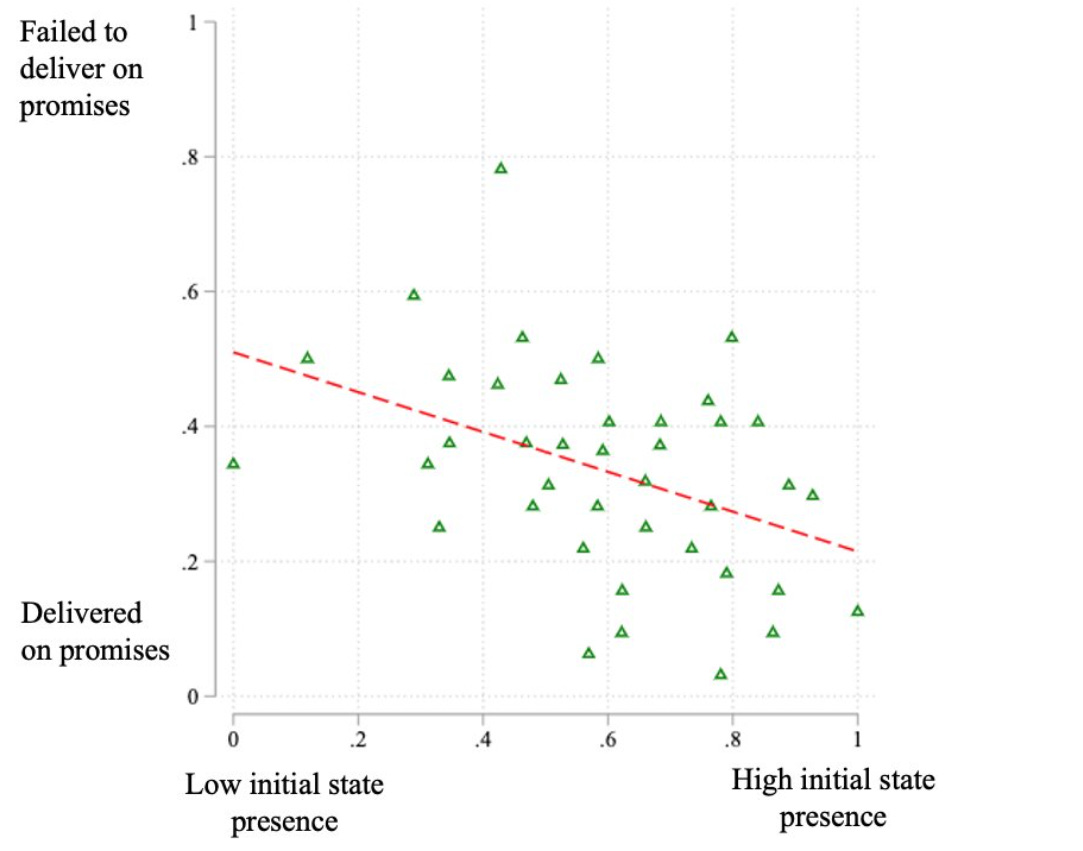
Based on these results, BDLT believe that for these weak local government presence neighborhoods, it might take a longer time of consistent intervention in order to change the perception of the local government. At first, the local intervention in these neighborhoods may not generate any returns (or even generate negative returns when factoring cost), but over time, as local government presence strengthens, positive returns from additional local government intervention can occur. This is known as the S-pattern of returns, shown below.

Whether this is true or not, would require additional research.
Conclusion
The study conducted by BDLT has a lot of valuable insights not only related to the question of local government intervention, but also methodological issues regarding interpreting data and experiment design.
First, the headline results stemming from this study can be deceiving. The reason there was no impact of increased local government intervention was due to the fact that in high local government presence areas, the impact was positive, while in low local government presence areas, the impact was negative. Therefore, the average came out as zero. But clearly, once we condition on local government presence, the study showed that there are positive impacts from increasing local government presence. By just focusing on the headline results, policymakers can end up making wrong decisions.
Secondly, the above also shows how important it is to consider a wide variety of factors prior to conducting a study and when evaluating study results. Had the authors not collected information on local government presence prior to the study, we would erroneously conclude that increased local government interventions have no impacts.
Regarding the overall impact of increasing local government intervention, this study shows that it is a complicated issue. In neighborhoods that have the weakest local government presence, which city officials would typically want to target the most to improve, initial investments in local intervention might not pay off for a while. Improvements might only be visible after many years of consistent government intervention, and that any initial lack of any improvement might be expected. However, in areas that have higher local government presence, additional investment appears to have large positive impacts on crimes and government legitimacy. Thus, in such areas, additional investment would improve outcomes immediately.
Naturally, this finding can impact local government decisions – if a mayor of a city wants to see immediate results to improve their electoral chances, they will invest in areas that already have high local government presence and spending. On the other hand, under-invested areas would continue to be neglected since they require multi-year continuous commitments, forever keeping these communities under-invested.
Interesting Reads from the Week
Article: Bharat Ramamurti discusses why price-controls (i.e. rent controls, goods price caps) can be a policy tool to tackle certain issues. At least, they should be studied quite a lot more rather than dismissed.
Note: Jeremy Ney points out an interesting new research which shows how liquid wealth alters people’s ability to find jobs, exacerbating wealth and income disparities.
Note: Tariffs imposed by the US continue to push US inflation higher, adding 0.7 percentage points to the inflation measure so far.