


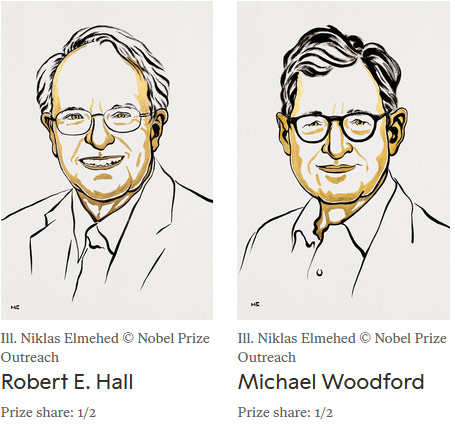
On October 12, 2026, the Sveriges Riksbank Prize in Economic Sciences, in Memory of Alfred Nobel, was given to Michael Woodford and Robert E. Hall for “microeconomic foundations of macroeconomic stabilisation.”
Both Woodford and Hall are well-deserved prize recipients and I’ll go over the contributions that led to them receiving the award. What makes this Nobel special, and to self-promote Nominal News a bit, the award was given for something that I have extensively written about in numerous articles – the New Keynesian model.
Nominal News is an economics newsletter written by a PhD Economist that translates the latest economic research into clear, policy‑relevant insights on current issues. It is a reader-supported publication. Join 4,000 readers to stay-up-to-date with Nominal News directly in your inbox:
Michael Woodford and Putting Together the New Keynesian Model
The main contribution by Michael Woodford highlighted by the Nobel is the formalization of the New Keynesian (NK) model.
The Problem – How to Properly Model Inflation, Interest Rates and Unemployment
Macroeconomic models can suffer from a problem called the Lucas Critique. Suppose you want to model how inflation reacts to interest rates. What you could do is look at historic data of inflation and interest rates, and specify a relationship between them. For example, based on such an analysis, you could determine if you raise interest rates by 1 percentage point, inflation will fall by 0.5 percentage points.
The problem with this approach is that we cannot be confident that the historic relationship between inflation and interest rates will continue to be true in the future. That’s because other factors, such as new policies or new technological developments, can alter this relationship. This issue was stated by Robert Lucas, and is now known as the Lucas Critique.
To avoid the Lucas Critique issue, we need to microfound the macromodel – that is to model the economic behaviors of people, firms and governments directly. By modeling how these economic actors make decisions, if there is a policy change or new technology, we can see exactly how these economic actors will respond. We no longer need to rely on historic patterns. This is what the New Keynesian model proposed by Woodford did (and also why the prize description mentioned “...microeconomic foundations…”).
We have discussed the NK model extensively, as it was extremely effective in guiding us through the pandemic economic disruptions. The key microfounded components of the NK model are that prices are set by firms based on the following three factors:
Real marginal cost (the additional cost to produce one unit of good)
Desired mark-ups (the profit firms want to earn)
Expected inflation (what firms believe inflation will be in the future).
Expected inflation is an important feature of the NK model and it comes from a microfounded assumption – ‘sticky prices’. Firms (or workers) do not change prices (wages) every day, but only occasionally. Therefore, when they do change the price, firms need to make an assumption of what inflation will be in the near future, because they will be locked in to the price they set for a period of time.
This ‘simple’ sounding model started quite a revolution in economics, and many more complex versions of this model have been made.
A Short History
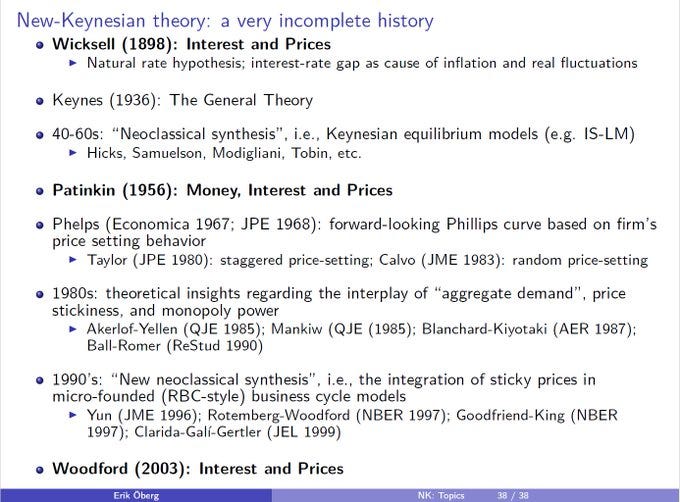
The NK model was not a flash in the pan, eureka moment. It took years of previous economics research. I, myself, do not know the entire history, but I will rely on Professor Erik Oberg’s lecture slide to show the amount of research that led to Michael Woodford writing down the formal model.
Forward Guidance
As an aside, one thing that I found a bit amusing about awarding the Nobel to Woodford now is the contrast between his view on forward guidance and the view espoused by current Federal Reserve Chair Kevin Warsh.
Forward guidance occurs when central banks telegraph their long run goals and actions. This can be very specific, including pointing out under what conditions a central bank will raise/reduce interest rates. Woodford, in a 2013 conference paper, said this about forward guidance:
“Inflation-targeting central banks have been notable for the amount of information that they provide to the public, not only about their longer-run goals, but about the way in which they expect to conduct policy in the future in order to achieve those goals. For reasons discussed above, I regard this development as a positive one. Greater clarity within the policy committee itself about the way in which policy is expected to be conducted in the future is likely to lead to more coherent policy decisions, and greater clarity on the part of the public as to how policy will be conducted is likely to improve the degree to which the central bank can count on achieving the effects that it intends through its policy. “
On the other hand, Kevin Warsh in August 28, 2026:
“To highlight one example, I have set out to change the form and function of the Fed Chairman’s so-called forward guidance. You might know about my long-time discomfort with early pronouncements of future policy decisions. I much prefer another path . . . and will make the case for it.”
The fact that Woodford just received the Nobel with an opinion that is in stark contrast to the current Federal Reserve Chair does seem like an amusing coincidence.
An Important Contribution
The Nobel to Michael Woodford is not without its critics. Quite a few economists believe that Woodford deserves the Nobel for his overall body of work, but that the NK model is not good and shouldn’t have been awarded the Nobel. I think the reason for such a view is that even among economists, there is a bit of factionalism and preference for one type of view of monetary policy and inflation.
The NK model challenged some of the previous theories on inflation – such as inflation being driven solely by monetary policy or by government debt issuance (“money printing”) – which may have not made everyone happy. Derivatives of the NK model showed us how inflation can exist absent any actual money at all.
My belief is that the NK model was crucial in guiding the US economy through the turbulent Covid period. Thanks to the NK logic, the US was able to prevent any major recessions and rebound very quickly as one of the best performing economies post Covid. And, yes, it did come with inflation, which ‘unfortunately’ was the cost of the policy. However, the alternative – a stricter central bank which would have kept inflation in check – would have resulted in a worse outcome for all.
Robert E. Hall – Figuring Out People’s Behavior
The main paper by Hall related to the Nobel prize focused on people’s consumption patterns.
In 1957, Milton Friedman proposed the permanent income hypothesis (PH), which posited that people will base their spending decisions in a given year by taking into account how much they will earn throughout their life. A person’s lifetime average annual income is referred to as ‘permanent income’. From this permanent income, people choose to spend a fixed proportion, leading to a smooth consumption profile each year.
Hall built upon this theoretical idea and demonstrated that people do follow this behavior when making consumption decisions. Hall showed three things:
Today’s consumption level of a person is the best guess at tomorrow’s consumption level;
Past consumption is not useful in forecasting tomorrow’s consumption (the past does not matter):
If a person has a wealth shock (for example, their stock market investments’ increase/decrease in value), people slowly adjust their spending over time to these shocks.
Hall’s key point was to show how much a person spends today is already influenced by what the person believes will happen to their income and wealth in the future. Why is this important?
Rational Expectations and Why Stimulating the Economy May Be Hard
Hall’s contributions gave us two things:
That people act by taking into account their beliefs about the future, i.e. rational expectations, and;
How to incorporate these rational expectations into a model.
This was then further incorporated by Woodford in the NK model, which is the link between the two Nobel prizes.
Another important implication of Hall’s work is about the impact of economic stimuli.
Spending matters for the economy – too much spending can lead to inflation, whereas insufficient spending can lead to a recession. During downturns, governments may want to boost the economy by giving people money.
But, if a person spends a fixed amount based on what they believe will be their lifetime average income, a one-off government payment should not alter a person’s spending. Receiving a single $2,000 check does not meaningfully impact a person’s lifetime income, and, thus, spending shouldn’t change. This means that the government might be unable to stimulate the economy when it needs to.
Foundations of Economic Research
The work by Woodford and Hall laid the foundations of a wide body of economic research. This Nobel is very well deserved, as their contributions have become an ubiquitous part of economics. Many research papers have extensively built on their work – some of which we have talked about before, and, which itself might win a Nobel prize in the future.
If you would like to support us in reaching our subscriber goal of 7,000 subscribers, please consider sharing this article and pressing the like❤️ button at top or bottom of this article!
Thanks I did not know about the NK Model. Informative